
What is Industrial Data Integration?
Industrial operations generate vast amounts of data through equipment, sensors, control systems, and software. However, this information is often fragmented across systems from different vendors, stored in incompatible formats, and siloed within individual facilities. Although the data exists, accessing and using it consistently across an organization can be difficult.
Industrial data integration is the process of connecting data from these sources, standardizing its structure, and adding context so it can be accessed, understood, and used consistently across an organization. These sources may include PLCs, SCADA systems, historians, sensors, edge devices, maintenance systems, and equipment supplied by different manufacturers. By bringing this information into a unified operational view, organizations unlock its value as a resource for improving performance across the entire operation.
With a data integration system deployed, organizations can monitor assets across multiple sites, identify performance issues more efficiently, preserve operational history, and support Industry 4.0 initiatives such as predictive maintenance and AI-driven analytics.
For an industrial operation to perform at an optimized level, the objective should not simply be to collect more data. It should be to make existing operational data usable for improving asset performance and reliability.
This article explains how industrial data integration differs from basic data collection, what the integration process involves, why industrial data often remains fragmented across systems, and what advantages integrated data provides to an operation. It also examines how organizations can establish an integrated data environment across legacy and modern systems without replacing their existing infrastructure, as well as what to look for when choosing an industrial data integration solution.
The core elements of industrial data integration
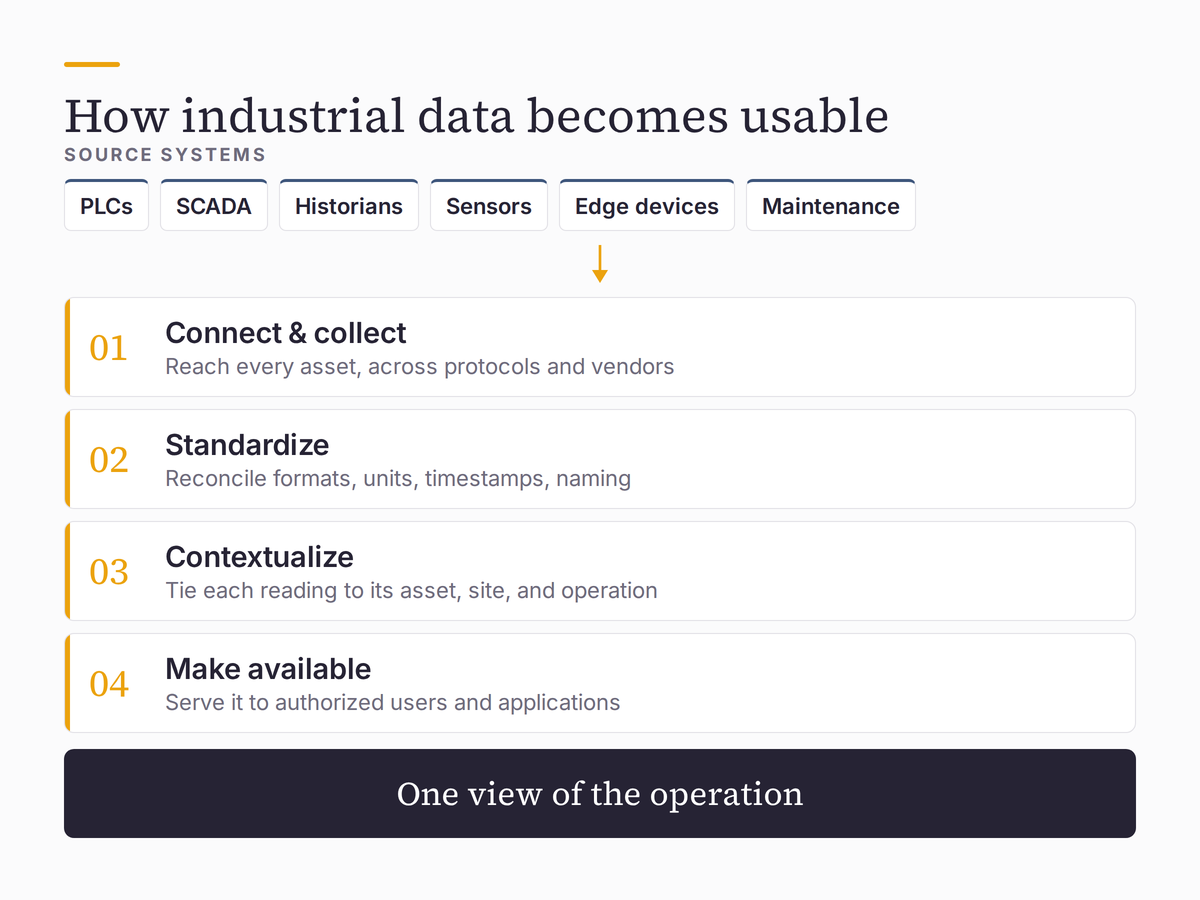
Connecting industrial assets and operational systems lays the groundwork for integration, but connecting industrial assets alone does not spontaneously integrate data. Data from these sources may use different formats, naming conventions, units of measurement, and timestamps. To make that data usable across an organization, these differences must be standardized and context must be added to identify what each data point represents, which asset produced it, where that asset is located, and how the information relates to the broader operation.
Industrial data integration therefore involves several related functions:
Connecting to industrial assets and source systems
Collecting data from those sources
Standardizing formats, units, timestamps, and naming conventions
Associating the data with the appropriate assets and operational context
Making the resulting information available to authorized users and applications
Together, these functions create a shared operational data foundation that allows information from otherwise separate systems to be mutually intelligible and utilized as a unified operational resource.
Why industrial data is difficult to integrate
Industrial environments rarely operate through a single, standardized technology stack. Equipment is installed and replaced at different times, supplied by different manufacturers, and expected to remain in service for many years. As a result, the data needed to understand an operation is often contained inside of systems that were not originally designed to communicate with one another.
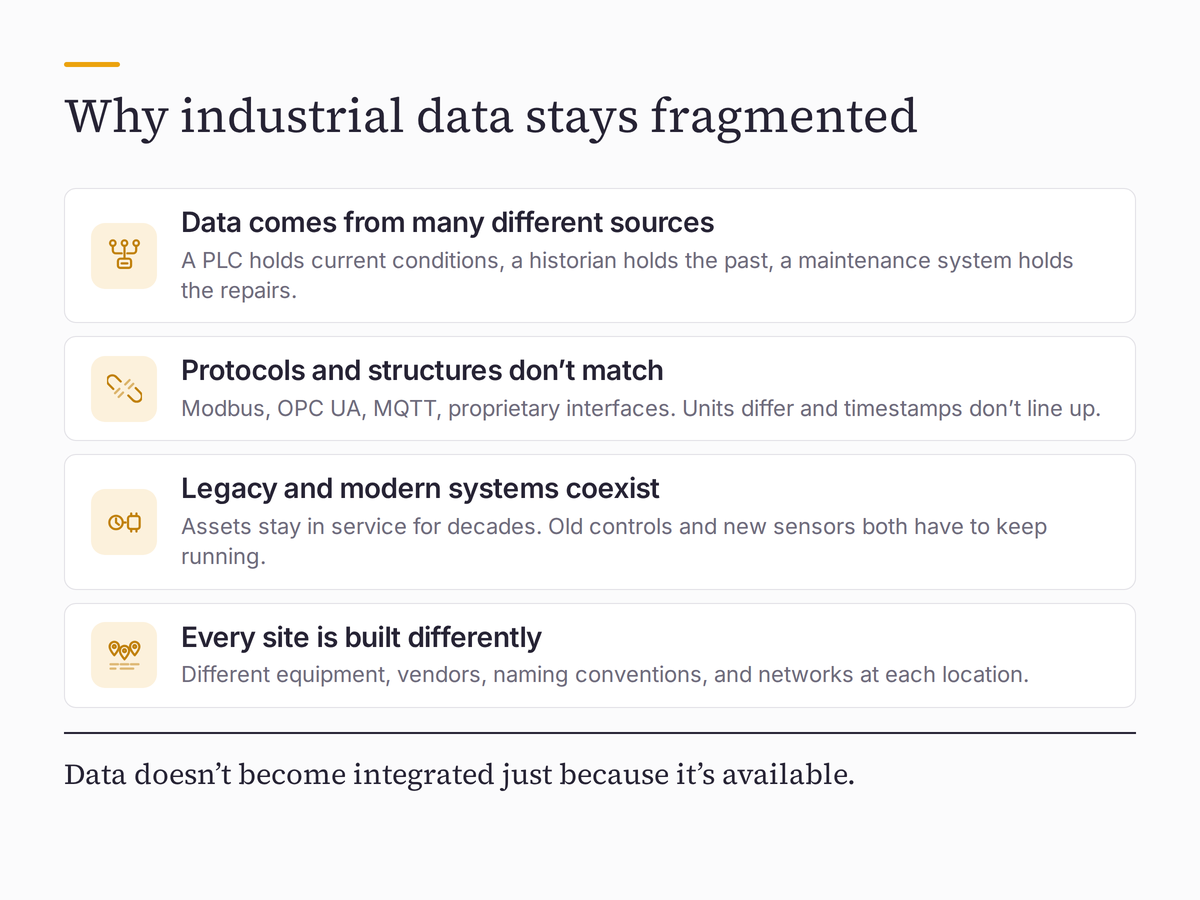
Industrial data does not become integrated simply because it is available. Several technical and operational factors must be addressed before information from separate systems can function as a unified resource.
Data comes from many different sources
Industrial data can originate from PLCs, SCADA systems, historians, sensors, edge devices, maintenance systems, and equipment-specific applications. Each source may collect a different part of the operational picture. A control system might record current operating conditions, while a historian preserves previous measurements and a maintenance system contains records of inspections and repairs.
Individually, these systems provide useful information. The difficulty arises when an organization needs to integrate this data to compose the complete operational picture.
Investigating an equipment failure, for example, may require operating data from a PLC, alarm records from a SCADA system, and maintenance history from another application. Without integration, users must move between separate systems and manually reconstruct what happened.
Systems use different protocols and data structures
Industrial assets and systems may communicate through different protocols (including Modbus, OPC UA, and MQTT), proprietary interfaces, and vendor-specific data formats. Even when data can be accessed, it may not be structured in a format that multiple systems can interpret.
To illustrate, one system might identify an asset by its equipment number, while another uses a site-specific tag name. Measurements may be recorded in different units, timestamps may not match, and operating conditions that are identical may defined identically in different facilities. Before this information can be compared or analyzed together, these inconsistencies must be resolved.
Legacy and modern equipment must work together
Industrial equipment is often used for decades. A single facility may therefore contain legacy control systems alongside modern sensors, gateways, and cloud-connected applications.
Older equipment may use protocols or interfaces that were developed before current connectivity and data standards existed. Additionally, replacing functioning equipment simply to improve data access may be costly and disruptive. Industrial data integration must bridge these generations of technology while preserving the availability and stability of the systems already supporting the operation.
Data streams can originate from multiple sites
The challenge becomes more complex for organizations operating fleets of assets across multiple locations. For instance, it is rarely the case that two different microgrid sites have identical configurations. Each site will probably have its own equipment, vendors, control systems, naming conventions, and network configuration. Even sites performing similar functions may organize their operational data differently.
These variations make it difficult to compare asset performance or create a clear, standardized operational view across the organization. Integrating data at the fleet level requires a common structure that can accommodate local differences while allowing assets and operating conditions to be evaluated consistently across sites.
These challenges are why industrial data integration involves more than capturing and storing data into a central location. The data must be connected, standardized, contextualized, and preserved in a way that accounts for the technologies and operating requirements of each facility.
Industrial data integration vs. data collection
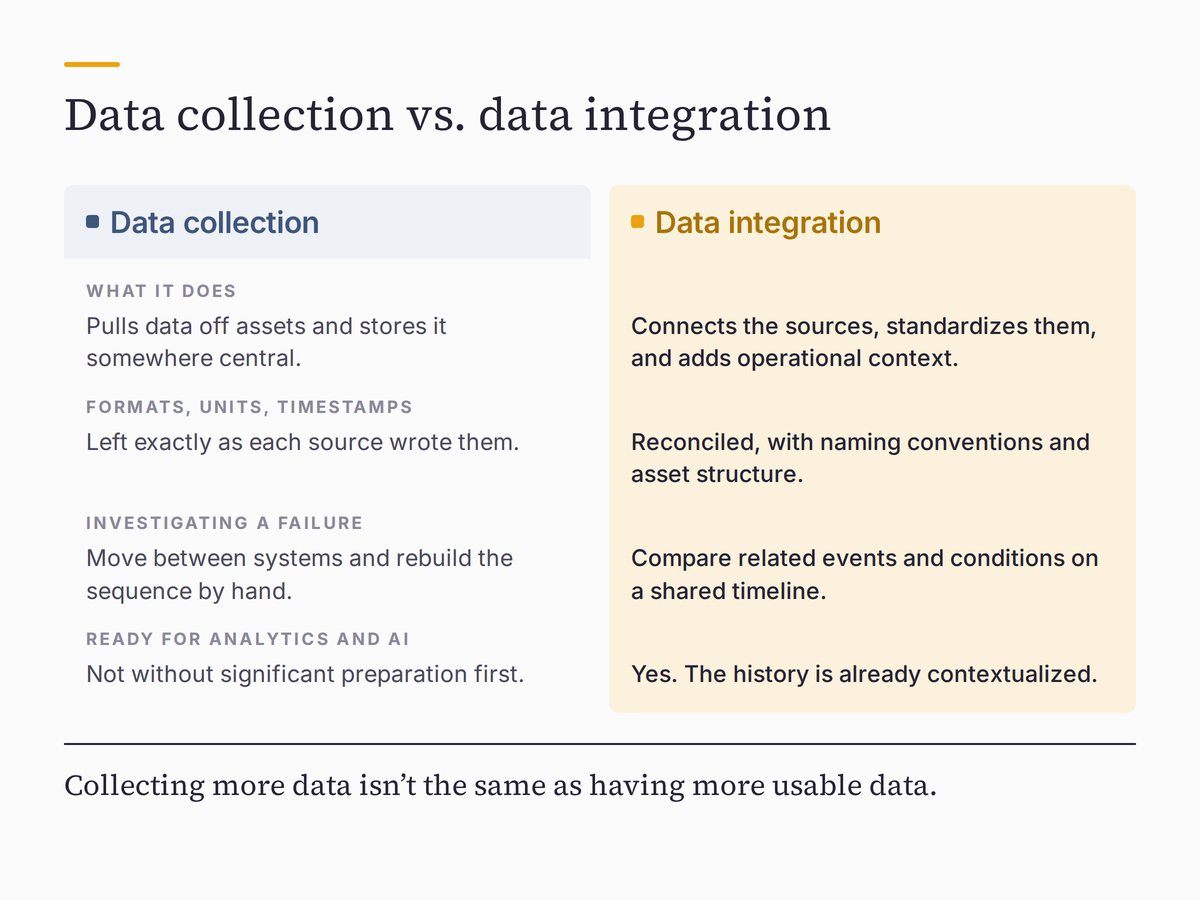
Data collection and data integration are sequences in the same workflow, but they serve different purposes. Data collection retrieves information from an industrial asset or system and stores it for later use. Data integration goes further by making data from multiple sources consistent, intelligible, and functional.
In regard to data collection, an organization may collect large volumes of data from PLCs, SCADA systems, historians, sensors, and other sources without having to integrate it. Transferring that data into a central historian, data lake, or cloud environment may improve access, but it does not automatically reconcile differences in formats, units, timestamps, naming conventions, or asset structures.
Making this distinction is imperative because the volume of data an organization possesses does directly correlate to useful that data is. Without standardization and context, users may still need to interpret records manually, switch between systems, or reconstruct relationships between data sources. Industrial data integration transforms collected data into a shared operational resource that can support monitoring, troubleshooting, reporting, maintenance, and advanced analytics.
Advantages of industrial data integration
One authoritative industry source estimates that as much as 90% of industrial operational data goes unused. By organizing information from different assets and systems into a consistent operational structure, integration allows that data to be used across monitoring, maintenance, reporting, and analytics workflows.
Unified asset monitoring
Without integration, operators may need to move between separate SCADA systems, equipment interfaces, historians, and dashboards to understand asset performance. Each system presents only the information available within its own environment.
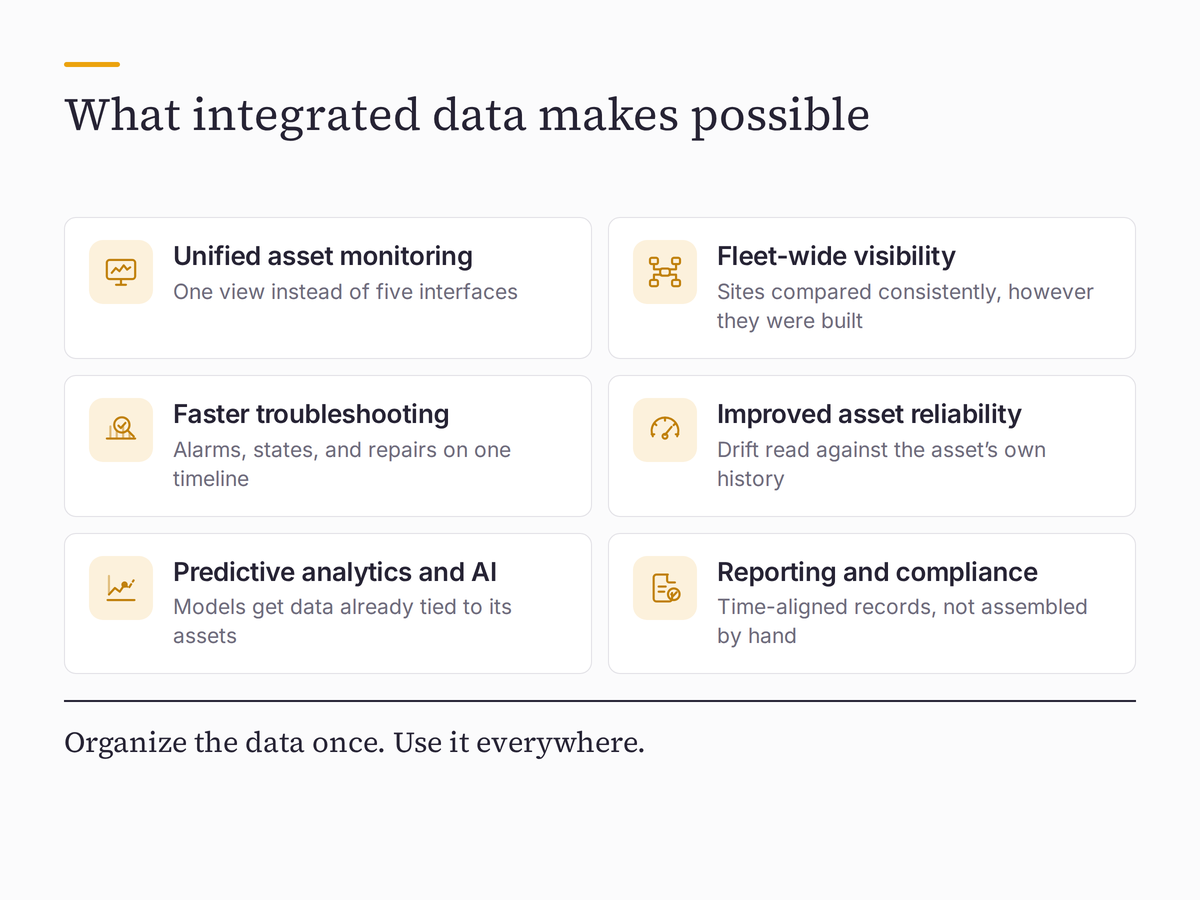
Industrial data integration merges data from these different sources, which sets up the unified monitoring of your operation’s infrastructure. Operators can see current conditions, alarms, operating history, and performance data without manually assembling information from multiple systems.
Fleet-wide visibility across multiple sites
Organizations with assets distributed across multiple facilities often lack a consistent way to evaluate performance across their fleet. Two different sites often never have identical builds. Which means that individual sites may use different equipment, control systems, and naming conventions, making direct comparison difficult.
By standardizing and contextualizing site-level data, industrial data integration allows assets and operating conditions to be evaluated consistently across locations. This gives operators and managers visibility into every site while still preserving the details needed to understand local performance.
Faster troubleshooting and root cause analysis (RCA)
Investigating an equipment problem often requires data retrieved from several sources. Operators may need to review process measurements, alarms, equipment states, operator actions, and maintenance records to reconstruct the events leading to a failure.
Integrated data makes this information available within a shared timeline and operational context. Instead of manually searching through separate systems, teams can compare related events and conditions more efficiently, helping them identify contributing factors and determine the root-cause of a problem.
Improved asset reliability
When operational data is organized consistently over time, organizations can identify changes that may not be apparent from isolated readings. Recurring alarms, declining output, increasing temperature, abnormal vibration, or changes in operating efficiency can be evaluated in relation to the asset’s history and operating conditions.
This visibility helps teams recognize emerging issues earlier, prioritize maintenance based on asset condition, and implement predictive and proactive strategies to address problems before they result in more significant disruption
Predictive analytics
Predictive models and AI applications depend on data that is accurate, consistent, and connected to the operation it represents. Large volumes of unstructured or poorly contextualized data cannot be easily used for this purpose, even when that data has been collected over many years.
Industrial data integration creates the foundation these applications require by standardizing historical data and associating it with the correct assets, events, and operating conditions. This allows organizations to apply analytics more effectively and incorporate predictive capabilities into their existing workflows.
Reporting and compliance
The same integrated data used for monitoring and reliability can also support operational reporting, incident investigations, and compliance documentation. Time-aligned records of equipment activity, system changes, alarms, and operator actions provide a more complete account of how an asset or facility was operating at a particular time.
Maintaining this information within a consistent data framework reduces the need to manually assemble records from separate systems. It also allows organizations to use the same underlying operational history for technical analysis, management reporting, and regulatory requirements.
Together, these capabilities transform industrial data from a collection of isolated records into a resource that can be leveraged in myriad ways across the organization. The more consistently that data can be accessed and understood, the more effectively it can support operational decisions, asset reliability, and long-term performance.
Does industrial data integration require replacing existing systems?
Industrial data integration does not necessarily require an organization to replace its existing equipment, SCADA systems, or operational communications infrastructure. In many cases, the systems already in place continue to perform their original control and data collection functions while an integration layer makes their information available for broader use.
A vendor-agnostic integration framework can connect data from legacy and modern technologies without requiring every asset or facility to use equipment from the same manufacturer. This allows organizations to standardize how operational data is structured and accessed while preserving the systems that already support day-to-day operations.
This approach is particularly important in industrial environments, where equipment may remain in service for decades and replacing functioning control systems can be costly and disruptive. Rather than undertaking a large rip-and-replace project, organizations can integrate existing systems incrementally as new assets, facilities, and data requirements are introduced.
The objective is not to interfere with the systems that control the operation. It is to create an overarching, consistent data layer as part of the system so information from different assets, vendors, and sites can be understood and used together. This allows organizations to improve visibility and make greater use of their operational data while protecting their existing technology investments.
How Keyfive creates a unified industrial data foundation
Effective industrial data integration turns information from separate assets and systems into a consistent operational resource. When data is standardized, contextualized, and made accessible across an organization, it can support everything from day-to-day monitoring and troubleshooting to long-term reliability initiatives and advanced analytics.
Keyfive’s vendor-agnostic framework integrates data from legacy and modern industrial systems, including SCADA systems, PLCs, historians, sensors, and equipment from multiple manufacturers. By working with the operational infrastructure already in place, Keyfive allows organizations to improve access to their data without requiring a rip-and-replace project.
The resulting data foundation gives operators a unified view of assets across multiple sites, preserves operational history, and prepares industrial data for reliability analytics, predictive maintenance, and AI. Whether you are integrating data across an existing fleet or establishing the foundation for a new monitoring initiative, Keyfive can partner with you to evaluate your requirements and determine the right approach for your operation.