
The Hidden Cost of Maintaining Homegrown Asset Monitoring Software
Summary: The cost of internally building your asset monitoring software extends well beyond its initial deployment. Security patches, integration maintenance, technical knowledge, and ongoing engineering support can steadily consume resources long after launch. Evaluating these responsibilities as part of the build vs. buy decision helps organizations understand the full cost of software ownership and make a more informed decision about which path to pursue.
For software companies, launch is one milestone in a product’s lifecycle. But companies that take on software projects often treat it as the endpoint, which means overlooking the ongoing cost of maintaining software long after it ships.
The hidden cost of building software is everything required to keep it running after launch. The initial build may require a significant investment, but it can be small compared with the cumulative cost of patches, upgrades, integrations, documentation, and retained technical knowledge. If that ongoing obligation is not planned for, it steadily consumes the people, time, and budget the company needs to invest in its core business and future growth.
For organizations deciding whether to build or buy asset monitoring software, the decision must account for the full cost of owning the software, not just the cost of shipping it. The hidden costs emerge after launch, when a completed project becomes an ongoing responsibility.
The decision to build or buy should be made with that entire commitment in mind.
The difference between “building software” and “owning software”
Once software enters an industrial environment, the work does not end, it just changes. And how it changes is development giving way to ownership. This means keeping the application reliable, secure, compatible, and useful as the systems around it evolve. From that point forward, the company is responsible for everything required to keep it operational.
Accordingly, this means that every dependency that needs updating, every SCADA integration that has to keep working as firmware changes, every new user or asset added to the fleet, every vulnerability disclosed against a library buried three layers deep in the stack, all of this belongs to whoever built the platform, for as long as the platform exists.
This is the distinction that matters most in a build vs. buy decision, and it's easy to lose sight of in the excitement of a successful launch.
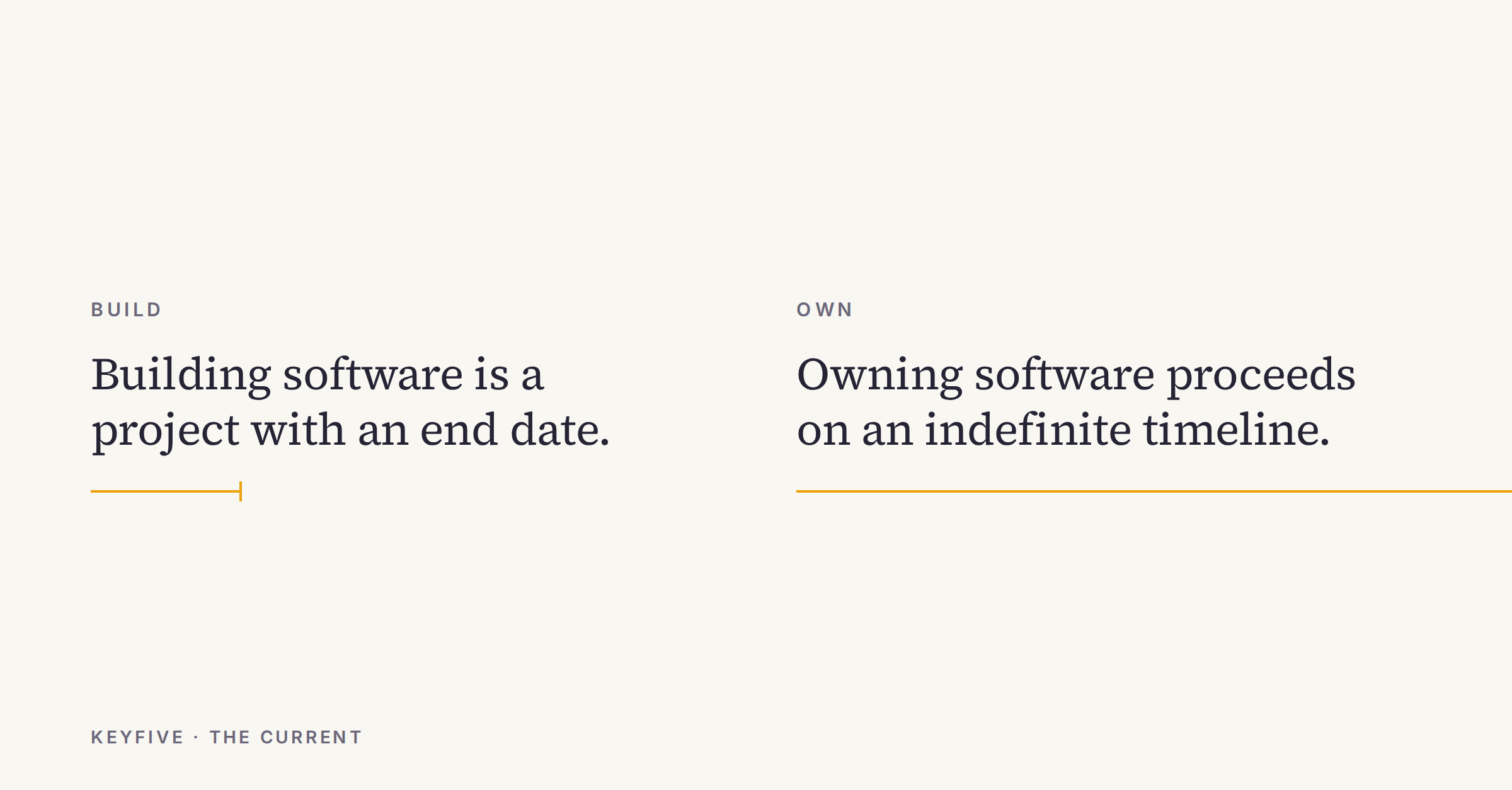
Building software is a project with an end date.
Owning software proceeds on an indefinite timeline.
The real cost of a build decision isn't what it takes to reach deployment. Rather, it's what it takes to keep the platform secure, integrated, and reliable every year after.
The four hidden costs of software ownership
The ongoing cost of owning software is rarely captured in a single budget or assigned to a single team. It builds over time through four recurring responsibilities that are often overlooked during the initial planning process.
In practice, these hidden costs show up in four areas: knowledge concentrated in a few people, security work that falls behind, integrations that deteriorate, and engineering time pulled away from the core business.
Key-person risk and tribal knowledge
Key-person risk develops when knowledge of an internal asset monitoring platform becomes concentrated among a small number of engineers.
If those engineers move to another project, take on new roles, or leave the organization, critical technical knowledge can leave with them. Without thorough documentation and a well-planned knowledge transfer, the remaining team may be able to operate the system but lack the knowledge needed to troubleshoot, maintain, or modify it confidently.
The company is then left owning software that it can operate today but may struggle to maintain in the future.
Security and patch debt
Initial development may end at deployment, but security work continues for as long as the platform remains in operation. Someone must monitor dependencies, identify newly disclosed vulnerabilities, evaluate their impact, and apply the necessary patches. When that work is deferred, unresolved vulnerabilities accumulate into security debt.
Recent data shows that this kind of security debt is widespread across organizations. Veracode’s 2026 analysis of more than 1.6 million applications found that 82% of organizations carried vulnerabilities that had remained unresolved for more than a year, while 60% carried critical security debt. The risk is especially relevant in industrial environments: Dragos recorded ransomware attacks against 3,300 industrial organizations in 2025, and manufacturing accounted for more than two-thirds of the affected organizations.
Integration maintenance and decay
An asset monitoring platform depends on a network of connections to SCADA systems, PLCs, data historians, and equipment from multiple vendors. Over time, firmware updates, protocol changes, equipment replacements, and discontinued vendor support can disrupt those connections.
Without ongoing maintenance, an integration may fail outright or begin producing missing, delayed, or inaccurate data. Keeping these connections reliable requires continuous monitoring, testing, troubleshooting, and engineering work. This represents time and resources “costs” that are easy to overlook when budgeting for the initial build.
When software maintenance diverts resources from the core business
Maintaining an internal platform can require engineering time that would otherwise support the core business. That “hidden cost” can be substantial because it can affect the business for years to come.
To illustrate, Sonar estimated that addressing technical debt in a million-line codebase can consume the equivalent of more than two and a half full-time engineers each year.
For industrial organizations, that capacity could instead support operational improvements, product development, customer needs, or other business priorities.
Doesn’t AI reduce the maintenance burden?
AI-assisted coding can reduce the time required to troubleshoot problems, generate patches, refactor code, and create tests or documentation. But it does not eliminate the need for engineering oversight. Someone still has to identify the right problem, provide the necessary system knowledge, validate the proposed change against the platform’s equipment and integrations, and ensure that it can be deployed safely.
AI may lower the cost of individual maintenance tasks, but it does not remove the ongoing responsibility for the software. As we discussed in our previous blog on AI-assisted coding in industrial applications, leveraging the value of AI still depends on sound engineering practices and human judgment.
Evaluating your software ownership risk
Hidden software costs often become apparent only after people, equipment, or connected systems change. Evaluating how prepared the organization is for those changes can reveal where ongoing responsibilities may have been overlooked.
Consider the following questions:
If the engineers who built the system became unavailable tomorrow, who could confidently maintain or extend it?
When were its dependencies and libraries last reviewed for known vulnerabilities?
How much engineering time is spent each month keeping the system operational rather than developing new capabilities?
Is the system’s architecture documented, or is that knowledge concentrated among the people who built it?
When were SCADA, PLC, and equipment integrations last reviewed or tested?
Is responsibility for ongoing maintenance formally assigned and accounted for in the budget?
The answers to these questions will clarify whether the responsibilities of software ownership are being met or are quietly being allowed to accumulate into technical debt.
If ownership is unclear, documentation is incomplete, or maintenance repeatedly pulls engineers away from other priorities, the organization may already be absorbing costs that were not included in the original decision to build.
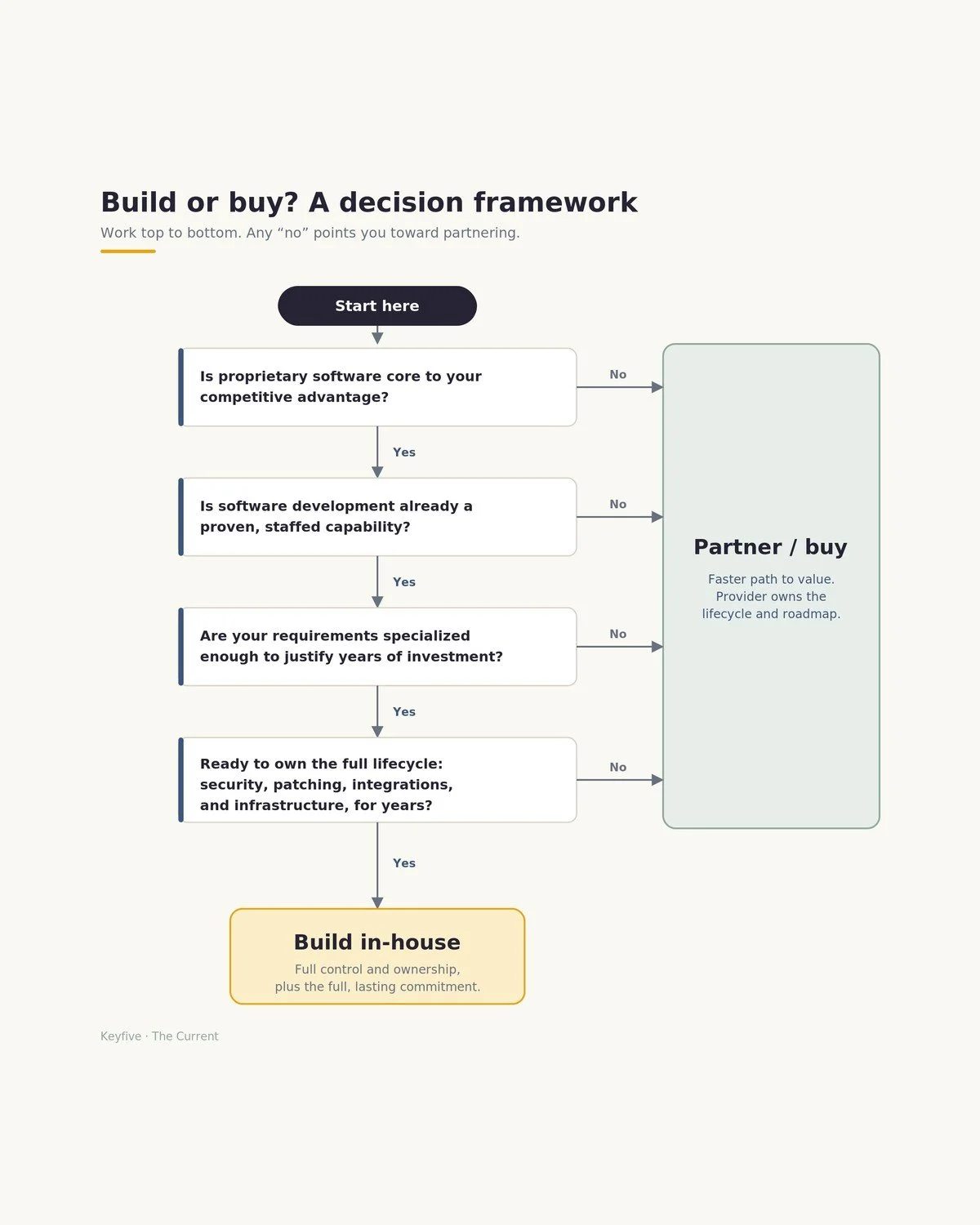
When the full cost of software ownership favors buying
Building software makes the most sense when the requirements are truly unique, the engineering capability already exists, the software itself creates a competitive advantage, and the organization is prepared to maintain it throughout its operational life. That final condition can be the hardest to sustain as teams, technologies, and business priorities shift. Therefore, for certain organizations, building is still the right decision.
For others, however, the self-assessment above may reveal that the ongoing cost of ownership would not support the rationale for building.
At that point, choosing an established asset monitoring solution is not a fallback.
It is a strategic decision to keep internal resources focused on the core business rather than maintaining the software throughout its lifecycle.
Reduce the burden of software ownership with Keyfive
An internally built asset monitoring solution may meet the organization’s original requirements. However, as equipment, integrations, security requirements, and business priorities evolve, hidden costs start to emerge with respect to time, resources, and budget.
Keyfive provides enterprise-grade asset monitoring and reliability software for complex industrial environments. By partnering with Keyfive, organizations gain the capabilities they need without requiring their internal engineering teams to carry the full burden of maintaining and advancing the software throughout its lifecycle.
Whether you are considering a new build or reassessing an existing internal solution, we can help you evaluate your operational requirements and determine whether Keyfive is the right partner for your organization.