
How Asset Monitoring Software Streamlines Compliance for Microgrid Fleet Operators
Summary: Managing compliance for one microgrid is manageable, but managing compliance for a microgrid fleet is a substantial workload. Most operators still handle this manually, so the compliance burden grows right alongside the fleet. Here's why that breaks down at scale, and how asset monitoring software turns operational data into audit-ready evidence automatically.
Managing compliance across a single facility is demanding, but manageable.
However, managing compliance across a fleet of 30, 50, or 100 distributed microgrids quickly becomes cumbersome and time consuming.
As microgrids become more connected and more operationally sophisticated, operators face two growing compliance burdens.
The first is environmental compliance, such as Environmental Protection Agency compliance (EPA), which requires organizations to track individual asset operational data such as generator runtime hours, fuel consumption, maintenance activities, inspections, and other records needed to satisfy permit and reporting requirements.
The second is cybersecurity compliance, driven by NERC CIP principles, utility security requirements, and the need to maintain visibility and control over grid-connected assets.
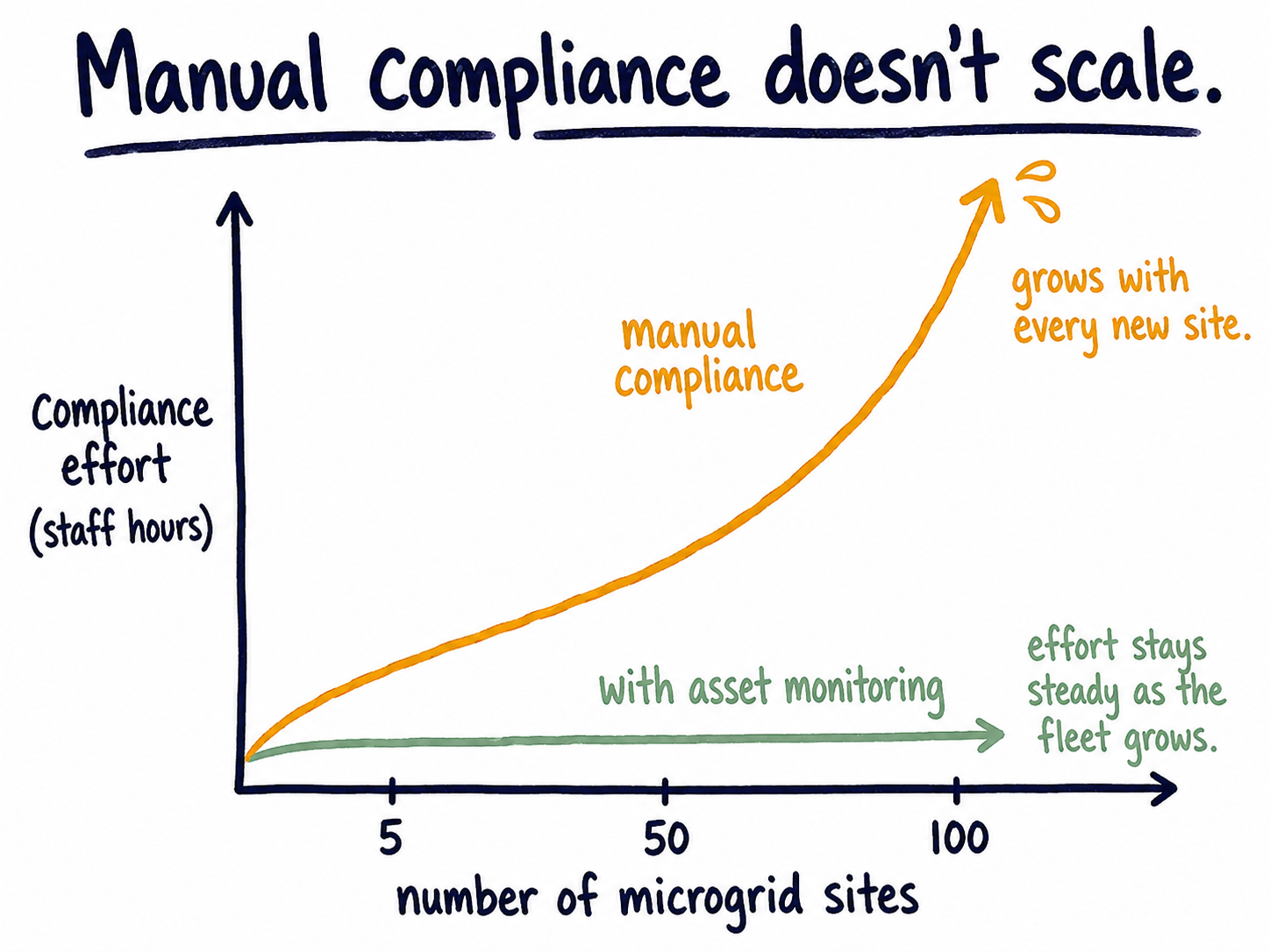
A lot of organizations still manage these obligations through manual processes. As microgrid fleets expand, however, manual compliance becomes an increasing drain on operational efficiency. Every new site adds more assets, more records, and more documentation that must be managed, causing the compliance workload to grow alongside the fleet.
Asset monitoring software helps operators step off the compliance treadmill. By automating the collection and organization of compliance evidence, it reduces the administrative effort that traditionally grows alongside every new microgrid added to the portfolio.
This post explores how asset monitoring software can transform operational data into audit-ready compliance records, streamline recordkeeping, and reduce the time required to prepare environmental and NERC CIP compliance reporting across distributed microgrid fleets.
The Two Compliance Burdens Facing Distributed Microgrid Fleets
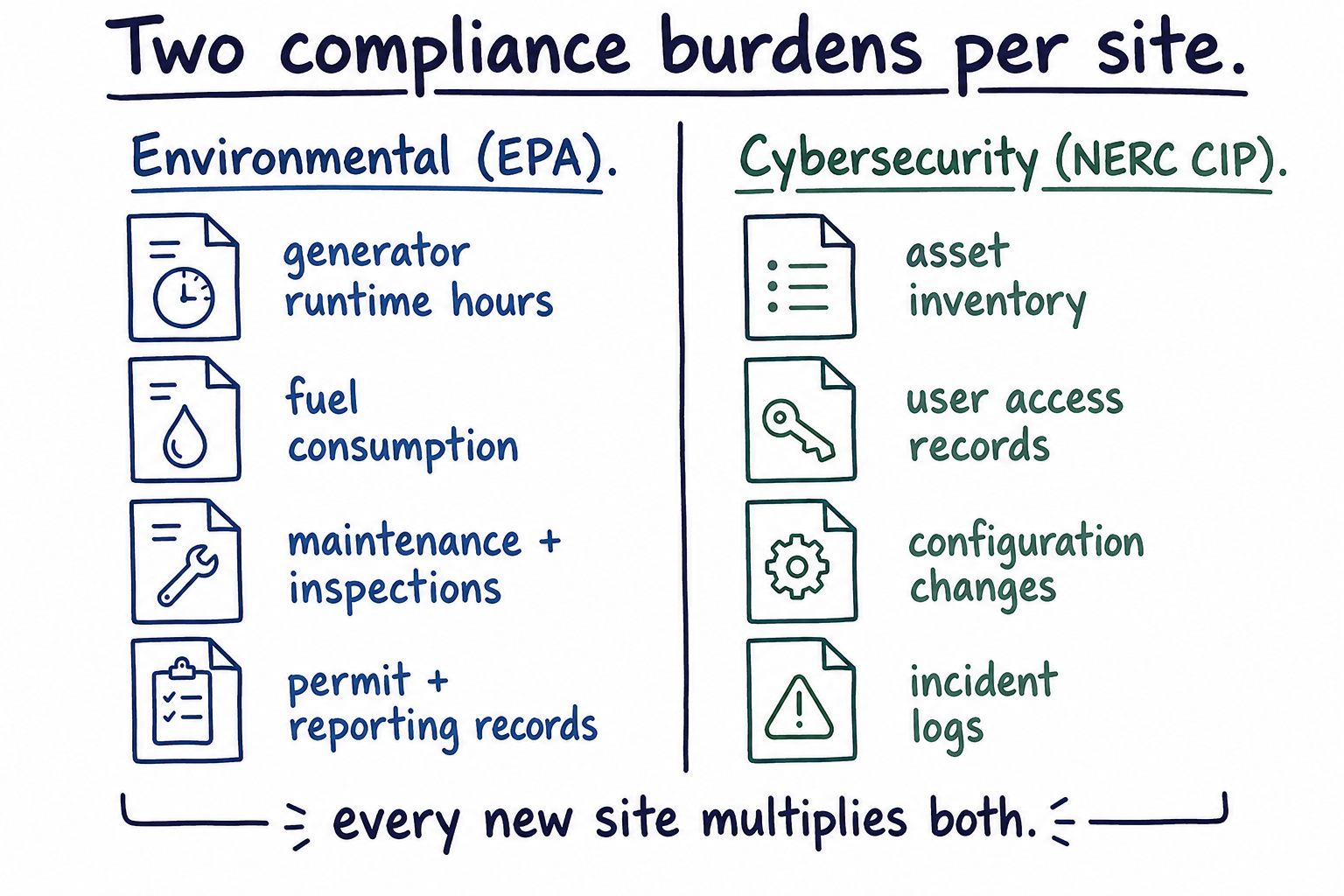
Many microgrid operators face multiple compliance obligations, but environmental compliance for fuel-powered generation assets and cybersecurity compliance for connected operational systems typically require the most ongoing operational oversight.
Environmental Compliance
For microgrids that rely on diesel or natural gas generators, environmental compliance is a continuous, time-intensive process that requires meticulous recordkeeping. Operators must maintain documentation of generator runtime hours, fuel consumption, maintenance activities, inspections, and other operational records that may be required for permits, reporting, or audits.
The challenge is not interpreting the data itself, it is maintaining consistent records across a distributed fleet of myriad assets. A single site may be manageable with spreadsheets and manual processes. But a fleet of dozens of sites creates thousands of operational events that must be tracked, retained, and made available when regulators, auditors, or internal stakeholders request detailed records on them.
As microgrid fleets expand, environmental compliance becomes less about understanding the regulations and more about efficiently managing the volume of data required to satisfy compliance standards.
Cybersecurity Compliance
Cybersecurity compliance presents many of the same operational challenges, but with a focus on connected assets and digital infrastructure.
Historically, only a small percentage of microgrids were subject to NERC CIP (North American Electric Reliability Corporation Critical Infrastructure Protection) compliance because most microgrids operated only at the local distribution level. However, based on the respective microgrid’s generating capacity, whether or not it uses an Inverter-Based Resource (IBR), or what the local utility company’s requirements are, this percentage is now closer to one-quarter of all microgrids are de facto required to meet these standards.
Requirements dictated by NERC CIP principles and utility security programs often depend on maintaining accurate, snap-shot inventories of connected assets, documenting user access, tracking incidents, and preserving evidence that security controls are functioning as intended.
In a distributed microgrid environment, assets are constantly changing. New devices are deployed, configurations evolve, user’s roles change, and systems are updated. Maintaining current records across every site can quickly become a significant compliance workload, making it increasingly difficult to maintain complete and accurate documentation to meet NERC CIP standards.
Without continuous visibility into connected assets and system activity, compliance teams are often forced to manually assemble documentation from multiple sources whenever an audit or assessment occurs.
Why Environmental Compliance for Microgrids Becomes Difficult at Scale
Environmental compliance is not a regulatory issue, it's a data management issue. Every diesel or natural gas generator produces operational records that include runtime hours, fuel consumption, maintenance logs, and inspection histories, that could be required for reporting, permits, or audits.
The challenge is not generating this information. The challenge is maintaining complete, consistent, and audit-ready records across dozens of sites and hundreds of assets. When compliance data is fragmented across maintenance systems, spreadsheets, site reports, and local databases, operators are forced into a reactive position.
Instead of continuously maintaining compliance, teams spend valuable time locating records, reconciling conflicting information, and assembling documentation only when it is needed.
As fleets expand, this reactive approach becomes increasingly difficult to sustain. Modern microgrid operations depend on real-time visibility and automation, yet many organizations still rely on manual compliance processes that were never designed to scale at the same pace as their infrastructure.
Why Cybersecurity Compliance Becomes Difficult at Scale
Cybersecurity compliance also becomes increasingly difficult as microgrid fleets become more connected, more distributed, and more complex.
Whereas environmental compliance focuses on how fuel-powered generators are operated, cybersecurity compliance focuses on understanding what systems exist, how they communicate, and whether appropriate security controls are being maintained.
As distributed microgrid fleets evolve, assets are routinely added, replaced, and reconfigured. Maintaining an accurate inventory therefore becomes a continuous process rather than a periodic exercise. Asset inventories, access records, system changes, and incident documentation all serve as evidence that connected systems are known, monitored, and properly managed.
Without a unified view of every asset across every site, maintaining continuous visibility into the operational environment becomes increasingly difficult. Instead of having an accurate, audit-ready snapshot of the fleet at any given moment, organizations are forced to reconstruct that picture from multiple systems whenever it is needed. As microgrid fleets expand, recreating that level of visibility quickly becomes an increasingly resource-intensive task.
The Cost of Tracking Compliance Manually
Environmental and cybersecurity compliance may address different risks, but they share a common operational reality: both require ongoing documentation, recordkeeping, and audit preparation.
In other words, a significant investment of time and man hours.
On a small scale, much of this work can be handled manually. Teams maintain spreadsheets, collect records from site operators, update asset inventories, and assemble documentation when audits or reporting deadlines arise. The process is time-consuming, but manageable.
But a problem starts to emerge as a fleet starts to grow.
Every new microgrid deployment adds:
Fuel-powered generators
Connected operational assets
Operational records
Maintenance logs
Compliance evidence
All of these must be tracked over time. As the volume of information grows, so does the effort required to maintain compliance.
For many organizations, scaling a fleet means scaling compliance headcount. More sites require more administrative effort, more time spent preparing for audits, and more resources dedicated to maintaining records across distributed operations. Without automation, compliance costs tend to grow alongside the infrastructure they support.
The most scalable compliance programs reduce manual effort by continuously collecting, organizing, and maintaining evidence as part of normal operations. When compliance records are generated automatically, organizations can expand their fleets without increasing workload at the same rate.
How Keyfive Streamlines Compliance with Asset Monitoring Software
Keyfive's asset monitoring system is designed to make compliance a byproduct of day-to-day operations rather than a separate administrative process. Our vendor-agnostic framework integrates with existing SCADA and operational control systems without requiring a rip-and-replace deployment. Keyfive can continuously collect operational data from every connected asset and normalize these data streams into a one operational view. This provides operators with unified, fleet-wide visibility of every monitored asset from a single dashboard.
As operational data is collected, Keyfive automatically preserves a time-aligned record of asset activity, system changes, operator actions, and equipment performance. Instead of searching through spreadsheets, maintenance systems, and site reports to reconstruct compliance records, operators can retrieve audit-ready evidence from a continuously maintained operational history.
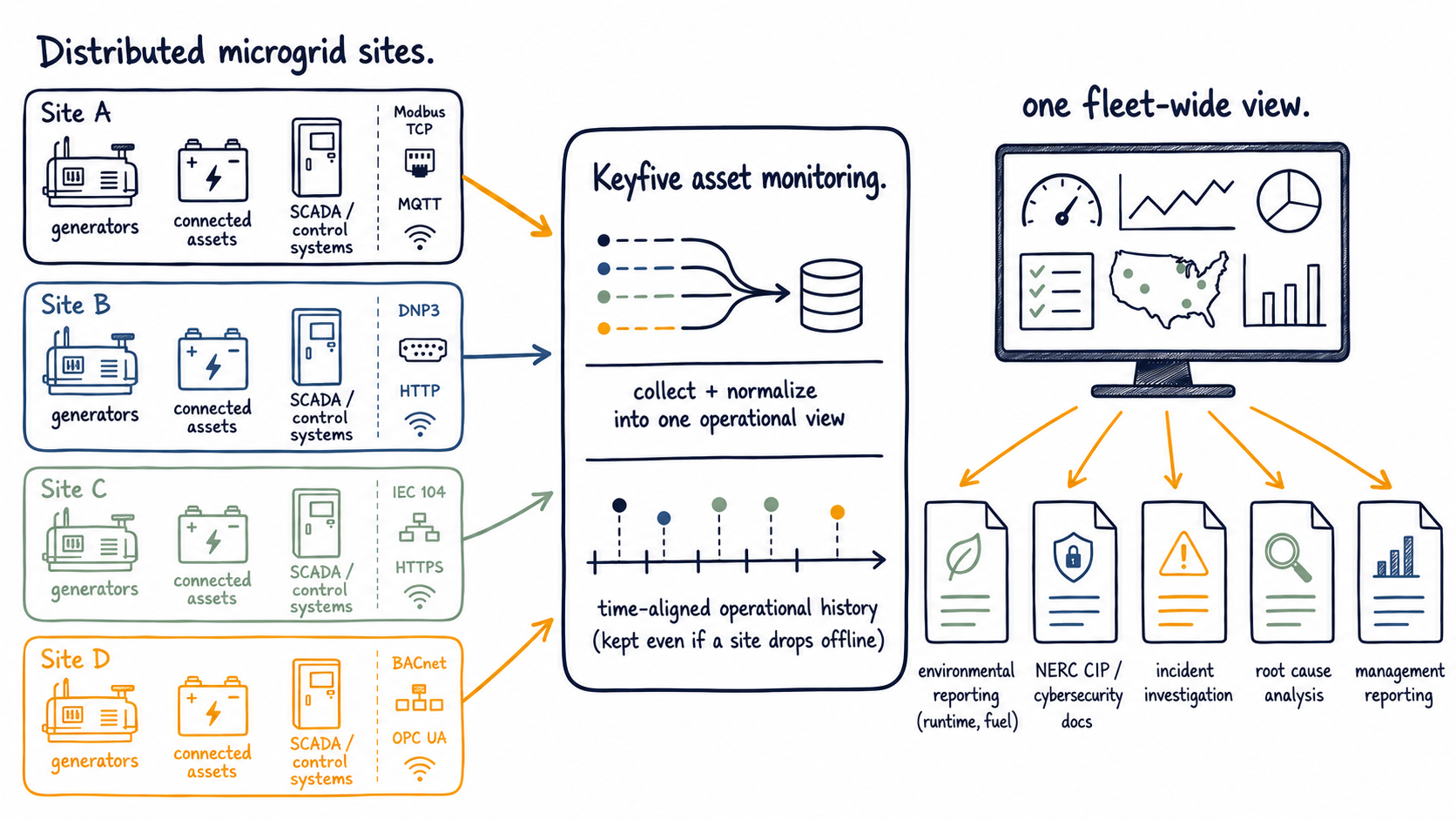
Our framework equips your organization with the tools for environmental regulation reporting, cybersecurity documentation, incident investigations, root cause analysis, and management reporting from the same underlying data. Even if individual sites temporarily lose connectivity, operational records are preserved and synchronized when communications are restored, maintaining the integrity of the compliance record.
The result is a shift from manually assembling compliance evidence to continuously maintaining it. Organizations can expand their microgrid fleets without increasing compliance staffing at the same pace, allowing operational growth without a proportional increase in administrative costs.
Interested in reducing compliance workload across your microgrid fleet? Contact Keyfive to schedule a consultation and learn how our asset monitoring platform can help.