
Summary: Building vs. buying asset monitoring software is one of the most important technology decisions an industrial organization will make. This guide explores when custom software development makes strategic sense, when partnering with an established solution delivers greater long-term value, and how advances in AI should influence the decision-making process.
Whether you're managing microgrids, manufacturing facilities, utility infrastructure, or other mission-critical industrial assets, deciding on your approach for asset monitoring software isn't simply a technology decision. It's deciding on a long-term strategy for how your organization develops and supports critical operational technology for years to come.
There is no universally applicable protocol for making this decision. For certain organizations, building internally provides the control and flexibility needed to support highly specialized operations. For others, partnering with an established platform offers a faster path to value, while allowing engineering teams to remain focused on their core business.
Understanding the trade-offs between these two approaches is the key to making the right decision.
To determine which approach best aligns with your organization's long-term objectives, it's important to understand the situations where developing an internal solution creates the greatest value, and in which instances partnering with an established software developer is the more practical option.
When Building Asset Monitoring Software Makes Sense
Before deciding to undertake an internal software development project, it's imperative to understand that you're committing to far more than the initial release. Every enhancement, security update, integration, infrastructure upgrade, and new capability becomes your organization's responsibility. Successful internal software development requires a long-term commitment to continuously improving the platform as technology and business needs evolve.
Organizations that successfully meet these challenges typically share several characteristics. If the following criteria accurately characterize your organization, developing an asset monitoring platform in-house may be the right long-term strategy.
Your Operational Requirements Are Unique Enough to Justify Years of Investment
If commercial software cannot adequately support your operational workflows, the long-term investment required for a custom solution may be justified.
Software Development Is Already a Proven Capability in Your Organization
Building an enterprise platform requires more than hiring a few developers. It requires a long-term commitment to recruiting, retaining, and growing a software engineering team capable of continuously improving the technology.
The Software Itself Creates Competitive Advantage
When software is a core component of your organization's competitive strategy, developing it internally may be the best way to preserve that advantage over the long term.
You Require Complete Ownership and Control
Regulatory requirements, intellectual property concerns, security policies, or architectural constraints may make owning every layer of the software stack a business necessity.
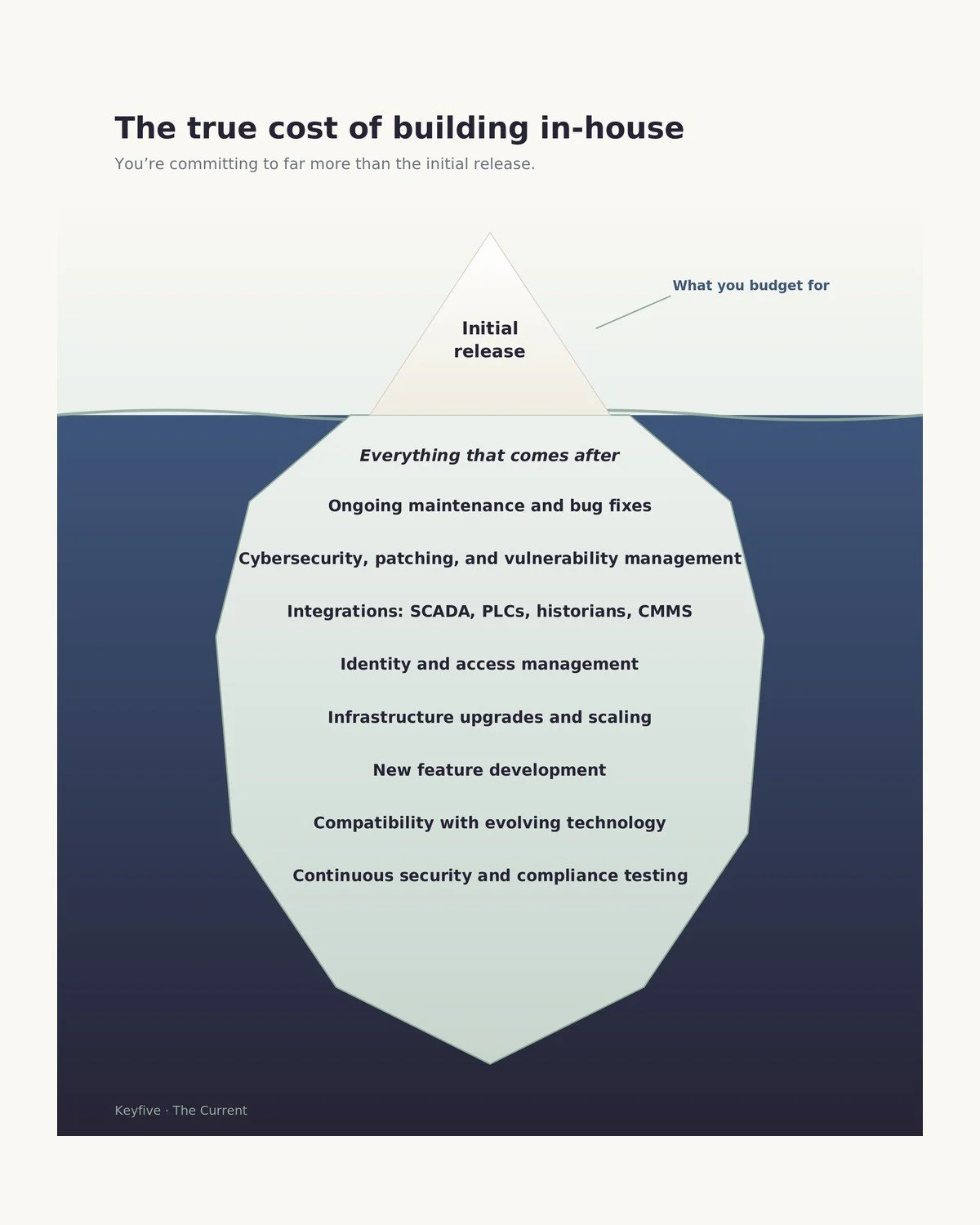
You're Prepared to Maintain and Evolve the Platform for the Entire Lifecycle
Enterprise software requires continuous investment in maintenance, cybersecurity, feature development, integrations, infrastructure, and compatibility with evolving technologies. Organizations that build internally should expect this commitment to continue long after the first version of the platform is deployed.
While these characteristics describe organizations that generally succeed with internal software development, not every business fits this profile.
Organizations whose competitive advantage depends on proprietary software often choose to build internally. Tesla, for example, has invested heavily in proprietary software because it is fundamental to its products and manufacturing operations.
Many industrial organizations recognize that their competitive advantage lies in designing products, operating critical assets, and serving customers, not in building enterprise-grade software. In these cases, partnering with an established asset monitoring solution allows engineering teams to remain focused on the work that creates the greatest business value.
When Partnering With a Software Provider Makes Sense
While internal development is the right strategy for some organizations, many companies ultimately determine that their competitive advantage lies in engineering and operating their business, not in developing enterprise software. In these cases, partnering with an established software provider allows organizations to accelerate their digital transformation while avoiding the long-term responsibility of owning, maintaining, and continuously evolving a software product.
Partnering with an established platform is often the right strategy if:
Your Operational Challenges Are Well Understood
Improving asset visibility, integrating operational systems, reducing downtime, and enabling predictive maintenance are common challenges for organizations ranging from microgrid operators and utilities to manufacturers and OEMs. Mature software solutions have already been designed to address these requirements.
Rapid Deployment Is a Priority
Instead of spending months or years developing and validating software, your organization can begin realizing operational improvements on a much shorter timeline.
Your Engineering Resources Are Better Utilized Advancing Your Core Business
Internal engineering teams create the most value when they're focused on improving products, processes, and operations rather than building and maintaining software.
Therefore, it would be far from ideal to have your internal team responsible for ongoing software innovation. Software requires continuous investment to remain secure, compatible, and current. An established software provider continually invests in cybersecurity, integrations, AI capabilities, user experience, and support for emerging technologies, allowing customers to benefit from ongoing innovation without owning the entire development lifecycle.
While these considerations remain the foundation of most build versus buy decisions, the rapid advancement of artificial intelligence has prompted many organizations to revisit the question. If software can now be generated faster and at lower cost, does it still make sense to buy instead of build?
How Has AI Changed the Build vs. Buy Decision?
Artificial intelligence has fundamentally changed how software is developed. Modern AI coding assistants can generate functional applications, automate repetitive programming tasks, and help developers prototype ideas in a fraction of the time previously required.
For organizations evaluating whether to build or buy an asset monitoring solution, these advances naturally raise an important question: If AI can write much of the software, does it still make sense to purchase an established solution?
The answer is yes. While AI has significantly lowered the barrier to software development, it has not eliminated the responsibilities that come with owning enterprise software.
“While AI has significantly lowered the barrier to software development, it has not eliminated the responsibilities that come with owning enterprise software.”
What AI does exceptionally well is accelerate software development. It can generate boilerplate code, create user interfaces, assist with documentation, and help developers iterate on new ideas much faster than traditional development methods. These capabilities make it an excellent tool for building prototypes and increasing the productivity of experienced engineering teams.
However, writing code is only one part of building enterprise software.
Industrial asset monitoring systems must integrate securely with:
SCADA systems
historians
PLCs
CMMS platforms
and other operational systems
They must also remain reliable enough to support critical business operations, scale across multiple sites, operate through network interruptions, and evolve alongside changing operational requirements throughout their lifecycle.
Security is a significant consideration. AI-generated code can introduce vulnerabilities, insecure design patterns, or subtle implementation errors if it is used without appropriate review and testing. Protecting operational technology environments requires far more than generating code. It requires secure software architecture, identity and access management, dependency management, vulnerability management, ongoing patching, and continuous security testing throughout the application's lifecycle.
Artificial intelligence has fundamentally changed how software is developed, but it has not fundamentally changed what enterprise software must deliver. Organizations evaluating whether to build or buy should view AI as a tool that accelerates software development, not as a replacement for the engineering, security, governance, and long-term investment required to own enterprise software successfully.
For organizations that determine partnering with an established solution is the right strategy, the next question becomes: What capabilities should you prioritize when evaluating asset monitoring software?
What Should You Look for in an Asset Monitoring Solution?
Selecting the right asset monitoring solution is about more than comparing feature lists. The software you choose should support your organization's operational objectives today while providing the flexibility to evolve alongside new technologies, additional assets, and changing business requirements. As you evaluate potential solutions, consider the following capabilities:
Vendor-Agnostic Architecture
Industrial environments rarely consist of equipment from a single manufacturer. The ideal platform should integrate with assets, control systems, and operational technologies from disparate vendors, allowing organizations to build a unified operational view without being locked into a specific ecosystem.
No Rip-and-Replace Required
Your existing SCADA systems, historians, PLCs, and operational infrastructure already represent significant investments. A modern asset monitoring solution should complement these systems rather than replace them, preserving previous investments while avoiding the cost, complexity, and operational disruption of a rip-and-replace implementation.
Integration with Legacy SCADA Systems
Many organizations rely on legacy SCADA systems that continue to perform their intended functions reliably. Rather than forcing organizations to modernize every control system simultaneously, the right solution should complement existing SCADA environments, making operational data available for enterprise-wide monitoring, analytics, and reporting.
Scalability
The software should be capable of growing alongside your organization. Whether you're adding new assets, expanding to additional sites, or integrating new technologies, the underlying architecture should support growth without requiring a complete redesign.
A Long-Term Product Roadmap
Software development doesn't end after deployment, and neither should your software partner's investment in the solution. Look for a provider with a demonstrated commitment to continuous improvement through regular feature enhancements, cybersecurity updates, support for emerging technologies, and a clear long-term product vision.
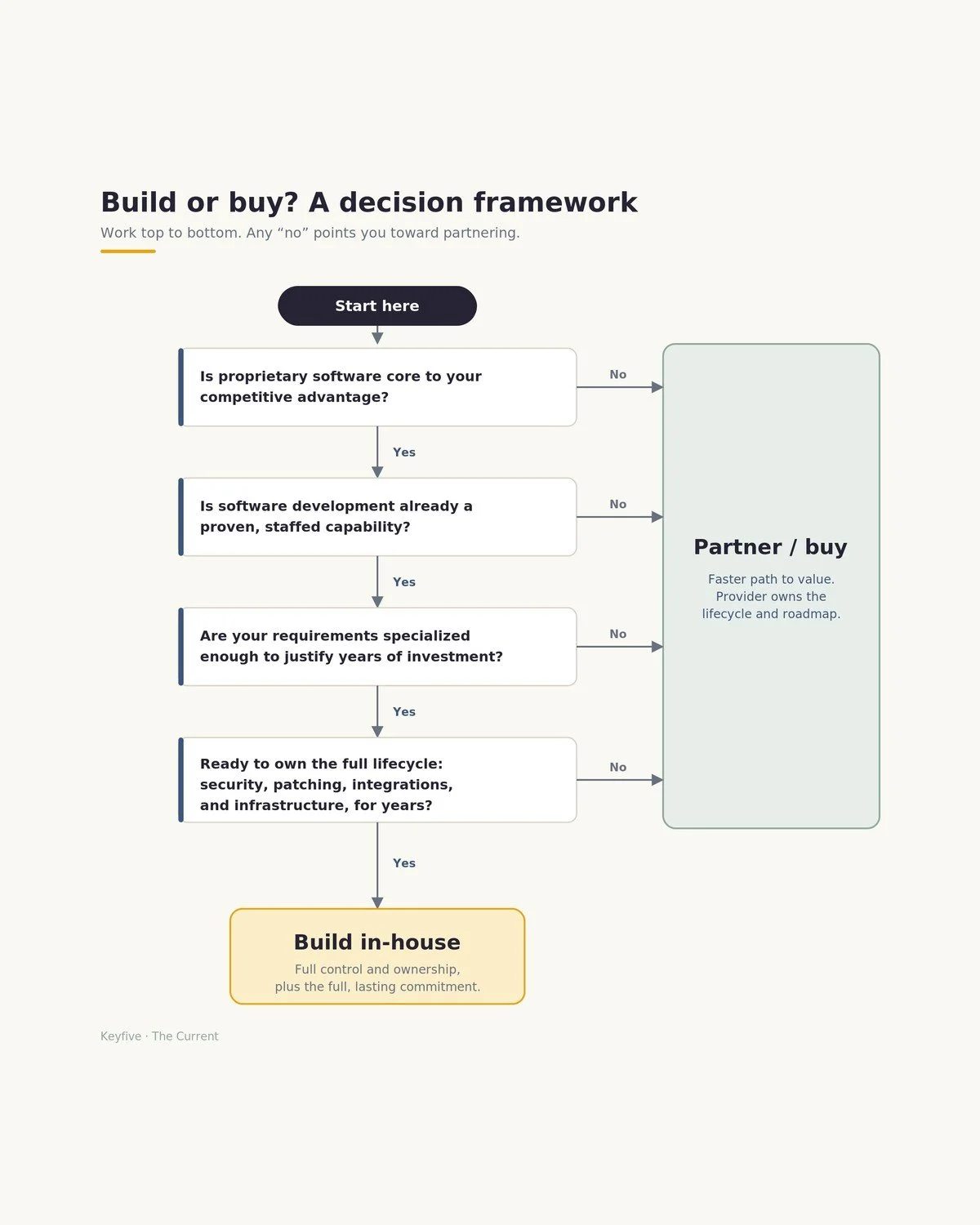
Ultimately, the decision to build or buy asset monitoring software is less about technology than it is about long-term strategy. The right choice depends on where your organization creates the greatest value, how you want to allocate engineering resources, and whether software development aligns with your long-term business objectives.
Final Thoughts
There is no universally correct answer to the build versus buy decision. The right choice depends on your organization's goals, capabilities, and long-term priorities.
For some companies, developing software internally is a natural extension of their product strategy and a capability they intend to invest in for years to come. For these companies, building an internal asset monitoring solution may provide the flexibility and control needed to support their broader technology roadmap.
For many organizations, however, software needs to support the business, not become the business. The question then becomes whether it makes strategic sense to dedicate engineering resources to designing, maintaining, securing, and evolving enterprise software, or whether those resources are better utilized in improving operations, accelerating product development, and delivering greater value to customers.
Ultimately, the build versus buy decision isn't simply about how quickly software can be developed or what it costs to acquire. It's about determining where your organization's time, expertise, and investment will generate the greatest long-term value.
Considering a Build vs. Buy Decision?
If you're evaluating whether to build or buy asset monitoring software, we'd be happy to discuss your operational requirements and help you determine whether partnering with Keyfive is the right option for your organization.
Frequently Asked Questions
When Should an Organization Build Asset Monitoring Software Internally?
Committing to the development of asset monitoring software can be a sound decision for an organization if:
The software itself provides a competitive advantage
The operational requirements cannot be adequately supported by an already established solution
An organization should also have a proven track record in software engineering and be prepared to make a long-term commitment to maintaining cybersecurity, integrations, compatibility, infrastructure, and feature development throughout the software’s lifecycle.
Rolls-Royce is one example of an organization that fits this profile. Its Engine Health Monitoring software differentiates its core products and services, and the company has the engineering resources to continually develop and support it.
How Has AI-Assisted Coding Affected the Build vs. Buy Decision?
AI-assisted coding has made it faster and less expensive to develop prototypes and certain software features internally. However, it does not eliminate the need for experienced software engineers or the long-term responsibilities associated with cybersecurity, system integration, testing, maintenance, and scalability. It has accelerated software development, but it has not fundamentally changed the build vs. buy decision.
What Should an Organization Look for When Choosing an Asset Monitoring Solution?
An organization should look for a solution that integrates easily with its current assets and operational systems, including legacy SCADA systems, without requiring a costly rip-and-replace. The solution should also adapt as operational requirements evolve and provide strong cybersecurity, fleet-wide visibility, scalability, data ownership and portability, and a clear long-term development roadmap.