
AI-Assisted Coding in Industrial Environments: Where It Works and Where It Falls Short
Summary: AI-assisted coding is helping industrial organizations develop prototypes, automate workflows, and create small internal applications more efficiently. However, generating functional code is only one part of delivering dependable industrial software. This article examines where AI-assisted coding provides real value, where it currently falls short, and why engineering expertise and long-term support remain essential in complex operational environments.
In less than four years, generative AI has fundamentally changed how software is developed. AI-assisted coding tools can now generate code, troubleshoot errors, create user interfaces, and turn ideas into working prototypes much faster than traditional development methods alone.
For industrial organizations, one of the clearest benefits is the ability to experiment more efficiently. Engineering teams can test ideas, automate limited workflows, and develop narrowly defined applications with less time and fewer development resources. However, a faster path to working code does not eliminate the requirements involved in deploying and supporting production-ready industrial software.
Understanding that distinction is essential to evaluating the role AI-assisted coding should play in industrial software development. Its value has already been demonstrated in focused, bounded development tasks and applications, but significant limitations remain when software must be integrated, secured, scaled, and supported over its complete operational lifecycle.
How AI-Assisted Coding Factors Into the Build vs. Buy Decision
AI-assisted coding has lowered the technical barrier to developing software.
This increased accessibility can make building an internal asset monitoring solution appear more practical. Organizations may be able to test an idea, automate a specific workflow, or create a limited application without making the same initial investment in time and software development resources that would have been previously required.
For narrowly defined applications, this can be genuinely valuable. AI-assisted coding may help an organization create an internal reporting tool, customize an existing workflow, develop a proof of concept, or validate whether an operational idea is worth pursuing. In these situations, faster development can reduce experimentation costs and allow engineering teams to address problems that may not justify a larger software investment.
However, the ability to generate working code does not necessarily translate into the ability to operate dependable industrial software. A prototype may demonstrate that an application can work, but a production system must remain secure, maintainable, scalable, and reliable across changing equipment, operating conditions, and technology environments.
This is where the traditional build vs. buy considerations remain relevant. Organizations that build internally are still responsible for cybersecurity, data governance, system integrations, software updates, infrastructure, documentation, user support, and long-term compatibility. They must also determine who will validate AI-generated code, resolve failures, and maintain the application after its original developers have moved to other responsibilities.
The consequences of these limitations are particularly significant in industrial environments. Software may need to integrate with legacy SCADA systems, process data from equipment supplied by multiple vendors, maintain records through connectivity interruptions, and support operations across an expanding fleet of assets. A defect in an internal productivity tool may be inconvenient. A defect in software used to monitor critical equipment can affect operational decisions, regulatory reporting, asset availability, and safety.
AI-assisted coding has therefore influenced the build vs. buy decision without fundamentally changing it. It can reduce the time and effort required to begin developing software, but it does not eliminate the long-term responsibilities associated with owning that software. Organizations must still decide whether maintaining a production-grade application is an appropriate use of their resources and whether software development supports their core business strategy.
Where AI-Assisted Coding Is Delivering Real Value in Industrial Settings
AI-assisted coding is delivering the most value when it serves as a catalyst for the development of small, bounded applications. Like a catalyst in a chemical reaction, it accelerates the process without becoming the process itself.
It can help industrial organizations:
Create internal applications
Automate repetitive workflows
Build reporting and data-processing tools
Develop proofs of concept faster and with fewer development resources
One example is thyssenkrupp Automation Engineering, which has used Siemens Industrial Copilot to assist engineers with PLC programming, sensor configuration, and machine visualization. Rather than developing an entire industrial software system, the technology accelerates defined tasks within an established engineering process.
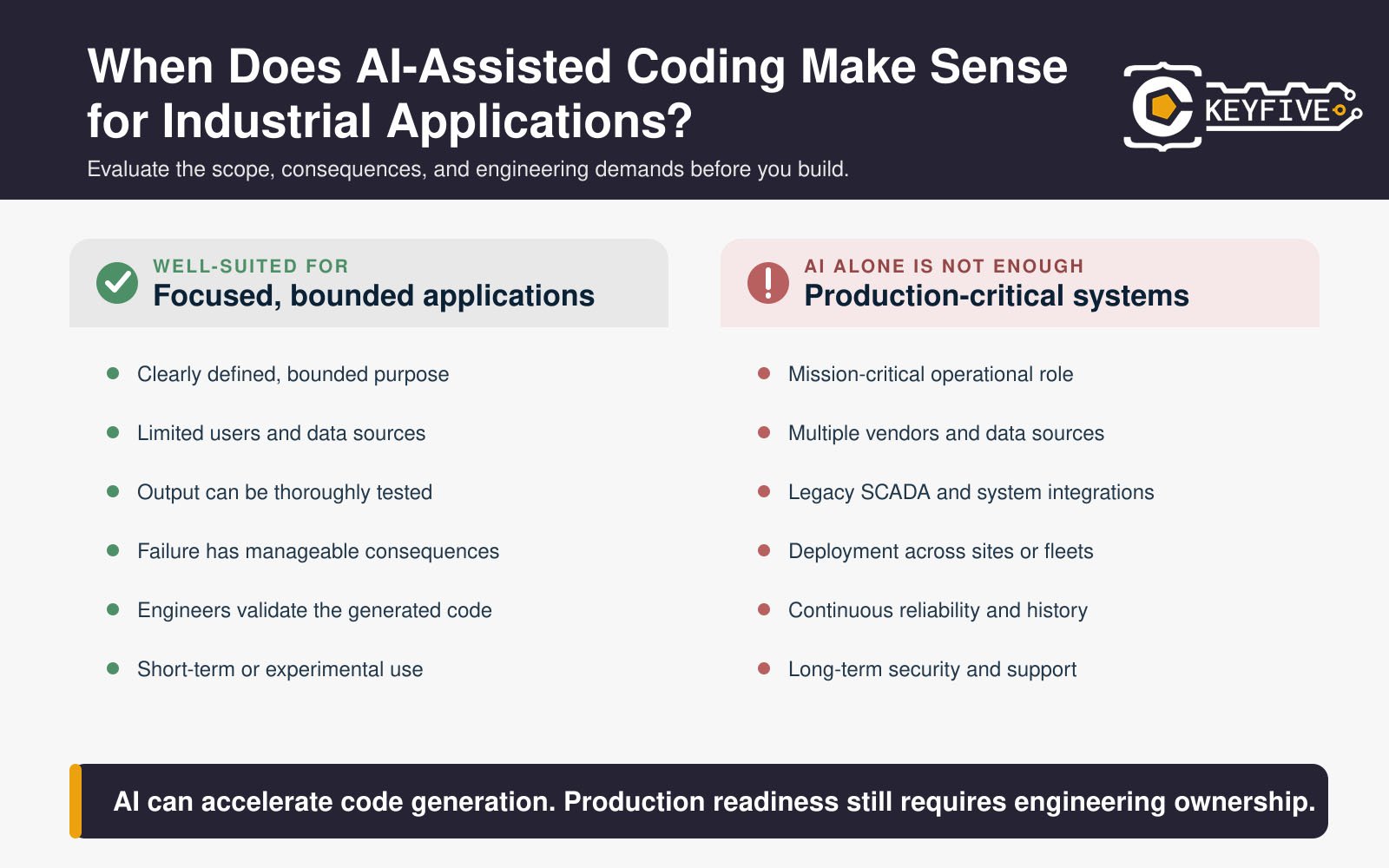
These applications typically have a clearly defined purpose, a limited number of users and data sources, and manageable consequences if something goes wrong. AI can accelerate their development, while experienced engineers remain responsible for reviewing, testing, validating, and deploying the resulting code.
Where AI-Assisted Coding Falls Short in Industrial Settings
These advantages make AI-assisted coding valuable for focused, well-defined projects. However, using AI to accelerate a bounded development task is fundamentally different from building and supporting software that must reliably operate across complex industrial environments.
AI-assisted coding can help create a functional application, but it cannot currently close the gap between a working prototype and production-ready industrial software on its own. Before deployment, the code must be tested under real operating conditions, secured against potential threats, integrated with existing equipment, and validated to ensure that it performs reliably.
In an operational environment, these requirements become more demanding when software must collect data from equipment supplied by multiple vendors, integrate with legacy SCADA and communication systems, preserve operational history, and support assets across multiple sites. Like removing the wrong block from a Jenga tower, a seemingly minor change to one system can destabilize the entire operation.
Furthermore, the responsibility continues long after the initial application is completed. Industrial software requires ongoing maintenance, cybersecurity updates, documentation, technical support, and adaptation as equipment and operating requirements change. AI can assist with some of this work, but it cannot assume ownership of the resulting software or its long-term performance.
The limitation is therefore not simply whether AI can generate functional code. It is whether the organization has the engineering capability and resources to validate, deploy, secure, and continually support what it creates.
Finding the Right Role for AI-Assisted Coding in Industrial Environments
AI-assisted coding is already providing real value in industrial environments. It can accelerate experimentation, automate repetitive development tasks, and serve as a catalyst for creating small, bounded applications. When the purpose is clearly defined and the output can be tested and validated, it can help engineering teams accomplish more with fewer development resources.
Its limitations become more significant when an application must move beyond a contained use case and operate as part of a complex industrial system. Production-ready software must be integrated, secured, documented, maintained, and supported throughout its lifecycle. AI can assist with each of these activities, but it cannot currently assume responsibility for the resulting software or its long-term performance.
Industrial organizations should therefore evaluate AI-assisted coding according to what they intend to build and why they intend to build it. The question is not simply whether AI can generate a functional application, but whether developing that application supports the organization’s objectives and whether it has the engineering capability and resources to maintain it once it becomes part of the operation.
Keyfive Can Move Your Operational Capabilities Far Beyond the Limits of AI-Assisted Coding
AI-assisted coding has greatly simplified the development of small, bounded applications intended for internal use.
However, when an industrial organization needs software that integrates with legacy SCADA systems, processes data from multiple equipment vendors, operates reliably across an expanding fleet of assets, and supports critical decisions over its full operational lifecycle, AI-assisted coding alone is not enough..
Keyfive develops enterprise-grade asset monitoring and reliability software for complex industrial environments. If your organization needs capabilities beyond what a prototype or limited internal application can reliably provide, contact Keyfive to discuss your operational requirements and how we can support them.
Request an Assessment
Frequently Asked Questions
Where Is AI-Assisted Coding Delivering Value in Industrial Environments?
AI-assisted coding is particularly valuable for focused tasks such as developing prototypes, automating repetitive workflows, creating internal reporting tools, processing data, and assisting with PLC programming. These applications have a defined purpose and can be tested before deployment.
Can AI-Assisted Coding Create Production-Ready Industrial Software?
AI-assisted coding can accelerate the development of functional applications. Secure, reliable, production-ready industrial software must be integrated, tested, secured, documented, maintained, and validated under actual operating conditions. This deployment is something that AI-assisted coding can deliver without having experience developers ultimately guiding the software development.
What Are the Risks of Using AI-Generated Code in Industrial Systems?
AI-generated code, in the absence of input and guidance from experienced developers, can potentially introduce security vulnerabilities, be composed of unreliable code, fail to be sufficiently documented, and be difficult to maintain over time. These risks become more consequential when software needs to connect to critical equipment, legacy SCADA systems, or a fleet of assets across multiple sites.
How Has AI-Assisted Coding Affected the Build vs. Buy Decision?
AI-assisted coding has reduced the time and resources required to begin developing software. Accordingly, this has greatly reduced the “barrier-to-entry” for making prototypes and limited internal applications. What it has not eliminated is the long-term responsibilities of production-ready software ownership, including cybersecurity, integration, maintenance, support, and compatibility.