
Why Legacy SCADA Is Becoming a Liability for Microgrid Fleet Operators
Summary: Legacy SCADA was built for centralized infrastructure and single-site operations. However, modern microgrid operations involve managing fleets of geographically distributed assets manufactured by multiple vendors. This article examines why legacy SCADA is becoming a liability for microgrid fleet operators, and how Keyfive extends existing SCADA infrastructure to deliver unified visibility, remote diagnostics, and automated compliance without a full system overhaul.
For nearly four decades, SCADA was the preeminent system used for industrial asset monitoring. It was developed for a world of localized infrastructure that consisted of fixed assets, analog instruments, and hardwired communication within a single facility. SCADA functioned well for the grid as it existed in the 1970s, 80s, 90s, and early 2000s.
But the grid has changed fundamentally over the last 20 years.
SCADA has not.
The Rise of Distributed Energy and the Microgrid
For most of the twentieth century, the electric grid operated on a simple and largely unchanged model. Power was generated at a small number of large, centralized plants via thermal generation from coal, nuclear, natural gas and transmitted over long distances to end users. Grid management meant manual monitoring of a handful of operationally simple assets whose behavior was already well understood.
The Supervisory Control and Data Acquisition (SCADA) system was purpose built for exactly this environment.
That model began to change in the early 2000s and has accelerated dramatically over the last decade. The rapid cost decline of solar and battery storage technology, combined with federal and state policy incentives, triggered a fundamental shift in where and how electricity is generated. Generation began moving away from centralized plants and toward distributed sources deployed at the facility, campus, and community level.
The grid that had been a one-way delivery system for a century began evolving into a complex, bidirectional network of distributed energy resources.
Out of this transition emerged the microgrid.
A microgrid is a self-contained energy system that integrates local generation, energy storage, and controllable loads into a single coordinated system. Unlike a traditional facility that simply draws power from the grid, a microgrid actively manages its own energy supply and demand in real time. Its defining characteristic is the ability to “island,” or to disconnect from the main grid and continue operating independently when grid power is unavailable or not economically favorable.
A modern microgrid deployment typically comprises a combination of the following assets:
Solar inverters converting photovoltaic generation into usable AC power
Battery energy storage systems (BESS) storing excess generation and dispatching it on demand
Backup generators providing dispatchable generation during extended outages or peak demand periods
Load controllers managing consumption across the facility in response to grid conditions and pricing signals
Smart meters measuring energy flows at key points throughout the system
Communication gateways and edge devices connecting physical assets to monitoring and control platforms
These components are rarely sourced from a single manufacturer. A typical microgrid deployment draws hardware from multiple vendors, each running their own communication protocols (Modbus, DNP3, MQTT, CANbus) and generating data in different formats.
Coordinating these diverse assets into one coherent, responsive system is not a small lift, and it represents the central operational problem that every microgrid deployment must solve.
For a single deployment, this complexity is manageable. But microgrid fleet managers are not managing single deployments. They are managing portfolios consisting of dozens, hundreds, or in some cases thousands of systems deployed across different customer sites, different time zones, and different regulatory environments. Each deployment is its own cluster of heterogeneous assets. Each cluster requires continuous monitoring, proactive maintenance, performance optimization, and in many cases regulatory compliance reporting.
This is the operational reality that legacy SCADA was never designed to address.
Why Scada Doesn’t Fit Microgrid Fleet Operators
To reiterate, whereas SCADA was developed to handle localized assets, monitored by analog instruments, and communicating by hard wire lines, microgrids fleet operators need to oversee myriad assets in multiple locations with many of these assets using different protocols to communicate over wi-fi, cellular, or ethernet connections.
Accordingly, the advance and proliferation of industrial internet-of-things (IIoT) technology has paved the way for an advanced level of monitoring and analytical capability over microgrid fleets that is simply not possible using a legacy SCADA system.
Continuing to use legacy SCADA limits the operational capabilities of microgrids in the following ways:
No Unified Fleet Visibility
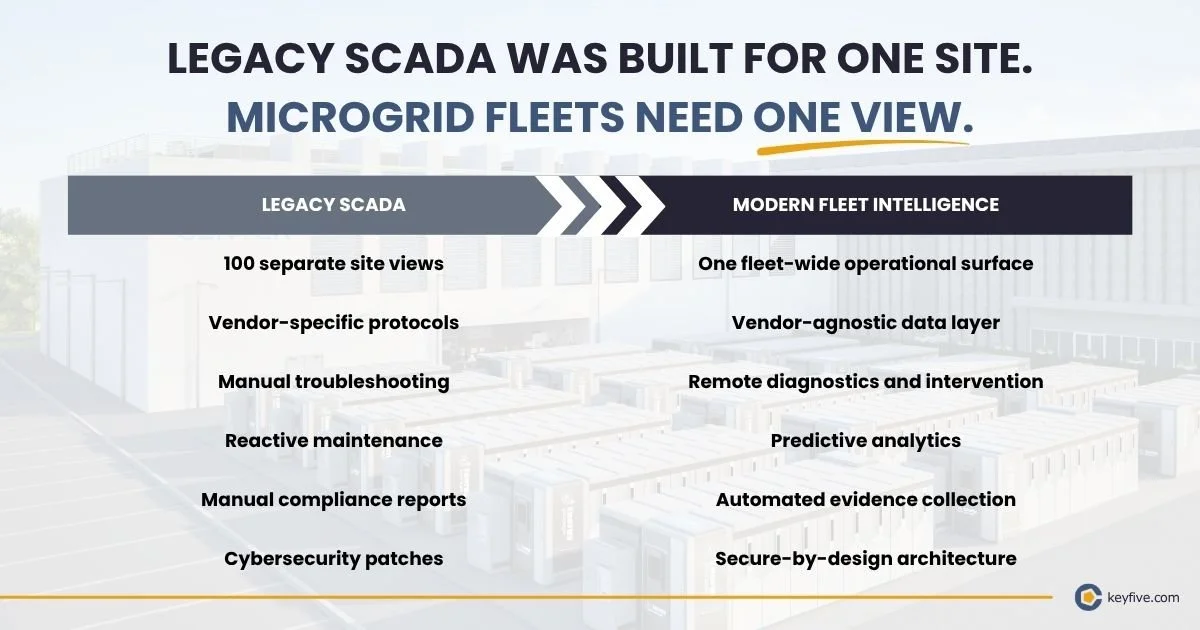
Operating 100 microgrid deployments on legacy SCADA means operating 100 separate SCADA instances. There is no consolidated view of fleet health, no centralized alerting, no ability to benchmark performance across deployments. Every operational question requires logging into a different system. This is not a minor inconvenience, it is a fundamental barrier to efficient fleet operations and proactive maintenance.
Cybersecurity Exposure
Legacy SCADA systems were originally designed as closed networks that were never transmitted over an internet connection. As connectivity requirements have evolved, these systems have been patched and extended in ways they were not designed to support. The result is aging infrastructure with significant security vulnerabilities, and this infrastructure is a huge liability that is subject to NERC CIP audit scrutiny. For microgrid fleet operators whose customers include utilities and critical infrastructure operators, this is a big area of concern.
Inability to Support Remote Operations
When something goes wrong at a microgrid deployment running legacy SCADA, the default response is often to send a team to the site. Dispatching a technician to a remote site to diagnose and resolve an issue is expensive, slow, and operationally inefficient. Modern microgrid operations demand remote diagnostics and intervention capabilities that legacy SCADA cannot provide.
Compliance Reporting Overhead
NERC CIP (North American Electric Reliability Corporation Critical Infrastructure Protection) compliance requires continuous evidence collection: asset inventories, access logs, configuration change records, security event documentation. On legacy SCADA, much of this data collection and report generation is manual. For microgrid fleet operators whose customers are subject to NERC CIP, the compliance burden falls on systems that were built decades before these regulatory requirements even existed.
What Modern Microgrid Fleet Management Actually Delivers
What’s missing from legacy SCADA isn’t incremental improvement, it’s a completely different operational model.
The objective of modern microgrid fleet management shouldn’t be better dashboards or more data points. It should be the ability to oversee and manage distributed energy systems as a cohesive fleet, rather than a collection of isolated sites.
In practice, that means:
Unified Fleet Visibility
Every site, asset, and system is visible in one view. Operators can monitor performance, track anomalies, and respond to issues across the entire fleet without jumping between systems. What was previously fragmented becomes operationally centralized.
Protocol-Agnostic Integration
Microgrids are inherently heterogeneous. A modern platform ingests and normalizes data across Modbus, DNP3, MQTT, CANbus, and other protocols, turning disconnected data streams into a unified operational layer.
Remote Diagnostics and Intervention
Issues can be identified, diagnosed, and often resolved without dispatching a technician. Instead of reacting to failures on-site, operators can take action remotely and reduce downtime and cost.
Automated Compliance Workflows
Compliance requirements like NERC CIP will still exist, but the manual effort to fulfill them can be greatly reduced. Data collection, logging, and reporting can be automated, turning a reactive, audit-driven process into a continuous compliance workflow.
For microgrid fleet operators, these aren’t emerging capabilities. They are the baseline required to operate distributed energy systems efficiently, at scale.
Keyfive Augments Legacy SCADA Without a Full System Overhaul
Legacy SCADA was not designed for modern microgrid management, but replacing it outright is rarely practical. These systems are deeply embedded in day-to-day operations, and rip-and-replace approaches introduce unnecessary cost, risk, and disruption.
The more practical path is to extend what already exists.
Keyfive’s Strata framework lays on top of existing SCADA infrastructure and becomes a component of a broader operational system. It connects directly to SCADA systems, historians, and CMMS platforms, and ingests data across each source and normalizes it into a unified view of the fleet.
Our approach does not eliminate SCADA.
It expands it.
SCADA continues to handle local control and data acquisition, while Keyfive enables cross-site visibility, fleet-level analytics, and operational coordination across all assets at all sites.
The result is a shift in how operators interact with their systems. What was once fragmented across multiple sites, interfaces, and protocols becomes a single operational surface for your entire portfolio.
For microgrid fleet operators, this means:
No disruption to existing SCADA deployments
No large-scale infrastructure replacement
No forced migration or reimplementation cycles
Instead, operators gain immediate access to fleet-wide visibility and coordination using the systems they already have in place.
Modernization, in this context, is not a replacement event.
It is an extension of capability.
If you’re interested in learning how Keyfive can modernize your Microgrid fleet, book a demo.
Frequently Asked Questions
Why Is Legacy SCADA Limiting for Modern Microgrid Fleet Management?
Legacy SCADA was built for a different era of grid infrastructure that was composed of fixed assets, analog instruments, and hardwired communication within a single facility. Modern microgrid fleet management involves managing distributed assets, digital instrumentation, and networked communication across multiple remote sites.
Fleet operators must maintain visibility across dozens or hundreds of distributed sites, each running its own combination of vendors, hardware, and communication protocols. Legacy SCADA has no native ability to aggregate and normalize data across deployments into a unified view, which means that operators are effectively managing each site in isolation.
As fleets expand, that visibility gap compounds and turns what should be a single operational surface into a fragmented set of disconnected systems.
Do I Need to Replace My SCADA System to Manage a Microgrid Fleet Effectively?
No, completely replacing a legacy SCADA system is rarely required. These systems are the linchpin of day-to-day operations, and a full rip-and-replace introduces unnecessary cost, risk, and disruption.
The more practical path is to extend what already exists. A modern microgrid fleet management platform can lay on top of existing SCADA infrastructure, connecting directly to SCADA systems, historians, and CMMS platforms, and normalizing data streams from each source into a unified fleet-wide view.
SCADA continues to handle local control and data acquisition while the modern platform enables cross-site visibility, remote diagnostics, and compliance workflows across the entire fleet.
Why Are Legacy SCADA Systems Viewed as Having a Higher Cybersecurity Risk?
Legacy SCADA systems were originally designed as closed networks without external network connectivity. As operational requirements evolved and remote monitoring became standard, these systems were patched and extended to support internet connectivity in ways they were never built to handle.
For microgrid fleet operators whose customers include utilities and critical infrastructure operators, this is a critical liability as these clients are required to meet NERC CIP regulations. As a result, every site added to the microgrid fleet not only augments the cybersecurity attack surface, but also compounds the burden of administrative work required to maintain NERC CIP compliance.