
Energy systems produce far more data than it makes sense to send to the cloud, so most monitoring systems check in intermittently. That works fine until something important happens between check-ins.
Fast Telemetry, a new software feature by Keyfive, closes those gaps. When something happens on site, it automatically sends high-resolution data from the moments around the event to the cloud, without manual data collection or the cost of streaming around the clock.
“It addresses concerns around cost management and operational complexity and enhances visibility and AI capabilities within the cloud layer," says Daniel Barnett, CTO of Keyfive.
What are the costs and benefits of processing high-resolution data?
To understand a fault, NERC requires hundreds of readings per second. But routine remote monitoring records far less often, anywhere from every few seconds to every 15 minutes, depending on the device. The reason is the cost. Streaming high-frequency data from every site gets expensive, especially over cellular.
The trade-off has consequences. Pecan Street found that one-minute data understated peak demand by about 20% compared with one-second data. Missing details matter even more when a site goes offline: the system looks fine in one reading and is down the next.
Oftentimes, the explanation lives in the high-resolution data stored on site. The challenge is extracting it from multiple devices, making sense of it, and getting it to the people who need it while it still matters. NERC’s standard requires that recorded data stay retrievable for only 10 days and be provided within 30 days of a request.
Every step adds time, cost, complexity, and room for human error.
How does Fast Telemetry work?
Fast Telemetry moves the first step of any incident investigation from people to the edge.
Edge monitoring keeps a rolling buffer of recent, high-resolution data. When it detects a sudden change, like a sharp swing in current, it doesn’t wait for anyone to notice. It sends that buffered window to the cloud right away.
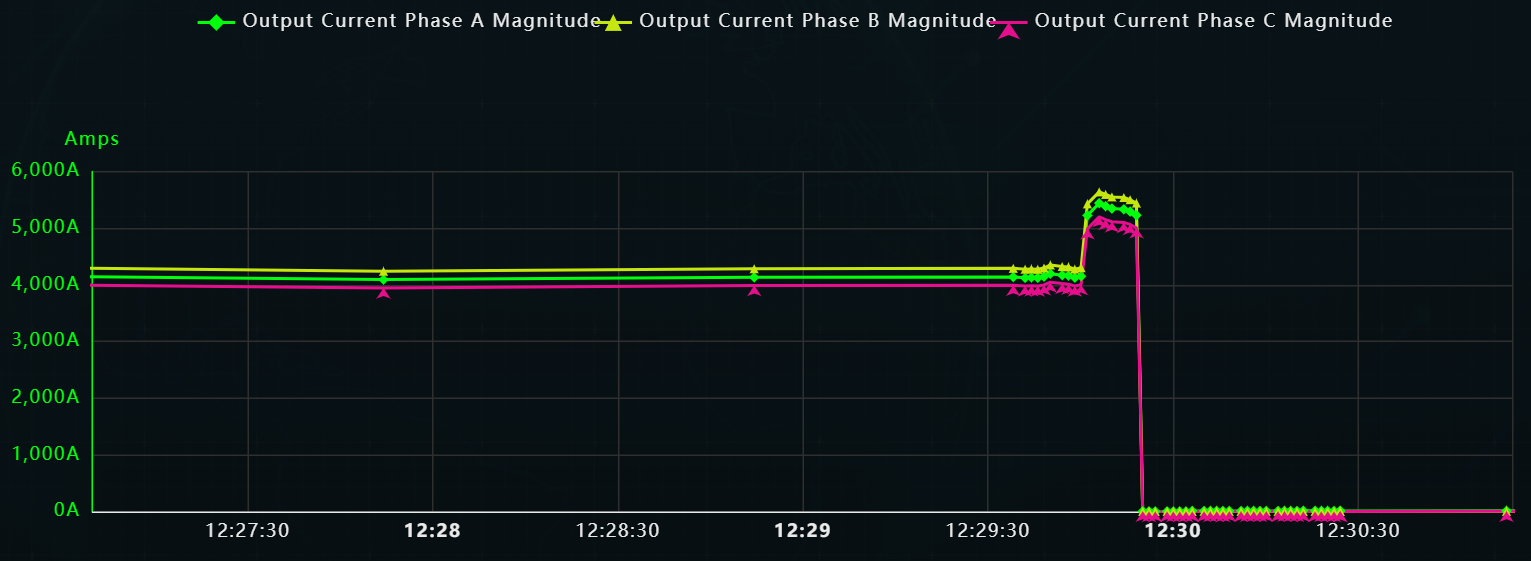
Fast Telemetry chart shows an overload of a microgrid system (12:29:30), when the system switches from normal telemtry (1-minute) to fast (1-second) during the event.
“Think of it as the instant replay for sports,” Barnett says. “If an interesting play happens, you want to go back and watch the video.”
Because extra detail only comes in when there’s something worth taking a closer look, streaming and storage costs stay low.
“We make optimal use of compute, optimal use of bandwidth, optimal use of server-side resources, to give operators the info they need, when they need it,” Barnett says.
Altogether, Fast Telemetry benefits site operators and service teams alike, and advances the system toward more autonomous and trustworthy AI workflows.
How does Fast Telemetry help operators find the root cause of an outage?
When a site trips offline, operators and engineers race to answer a slew of questions:
What caused my power system to go offline?
Why didn’t my monitoring system send an alarm?
Was the outage caused by our equipment, the utility, or the load?
How do I get root cause data without driving to the site?
Fast Telemetry puts the high-resolution data around an event in the cloud within moments, alongside the site’s operational history, so teams can start answering those questions right away.
“You get the high-frequency visibility you’d normally have to go to the Flight Recorder for, but it’s right there in the cloud,” Barnett says.
It also means fewer surprises. A brief overcurrent spike that falls between two once-a-minute readings would never trigger an alarm. Because the cloud now sees the spike, it does.
How can equipment manufacturers use Fast Telemetry to support customers?
When an incident occurs at a customer’s site, that extra detail gives everyone the same record to work from. So, equipment manufactures and their service teams can see what led to the event, whether the equipment was operating within its rating, and what happened next.
Warranty and service conversations can now start from what the data shows, rather than from competing accounts of what went wrong.
How does high-resolution data make AI more trustworthy?
AI is only as reliable as the data behind it. When working from once-a-minute readings, a model is forced to fill gaps with best guesses.
“If you summarize from truth, you get truth. If you’re summarizing from speculation, you’re going to get hallucinations and untrustworthy AI.”
Fast Telemetry gives Keyfive’s AI real evidence around the moments that matter. That’s the foundation for what Keyfive is building next: AI that doesn’t just flag an anomaly but explains what happened in plain English, with every conclusion tied to real evidence from the site.
Learn more about Keyfive’s latest technology releases in The Current.
FAQ
What is the difference between Fast Telemetry and a flight recorder or data logger?
The on-site recorder keeps the full high-resolution history. Fast Telemetry automatically sends the moments around an important event to the cloud, so teams don’t have to retrieve it manually.Does Fast Telemetry increase cellular data costs?
Only slightly. It sends high-resolution data in short bursts when something happens, instead of streaming it continuously, so costs stay low.What triggers Fast Telemetry?
A sudden change detected at the edge, such as a sharp swing in current.Does Fast Telemetry require new hardware?
No. The functionality is compatible with most on-site data loggers collecting high-frequency data.Does Fast Telemetry replace SCADA?
No. It gives the cloud the kind of detail that was previously visible only on the site’s local systems.
Learn what Fast Telemetry could catch at your site.