
AI has the potential to help industrial organizations detect developing equipment problems, identify production bottlenecks, and make better maintenance decisions.
If they have the right data.
Many operations already collect substantial amounts of information through sensors, SCADA systems, historians, and maintenance records.
But collecting data doesn’t automatically make it ready for AI. That information may be incomplete, fragmented across systems, or missing the context needed to interpret it.
Before investing in AI, organizations need to ask: Is our operational data suited to the problems we’re trying to solve?
What makes operational data AI-ready?
Operational data is ready for AI when it is relevant to the target application, sufficiently accurate and complete, and properly formatted and contextualized for analysis. Predicting bearing wear, for example, may require vibration readings and maintenance history, while identifying production bottlenecks may depend on cycle times, equipment states, and throughput data.
The requirements vary by application, but several qualities help determine whether the data is suitable:
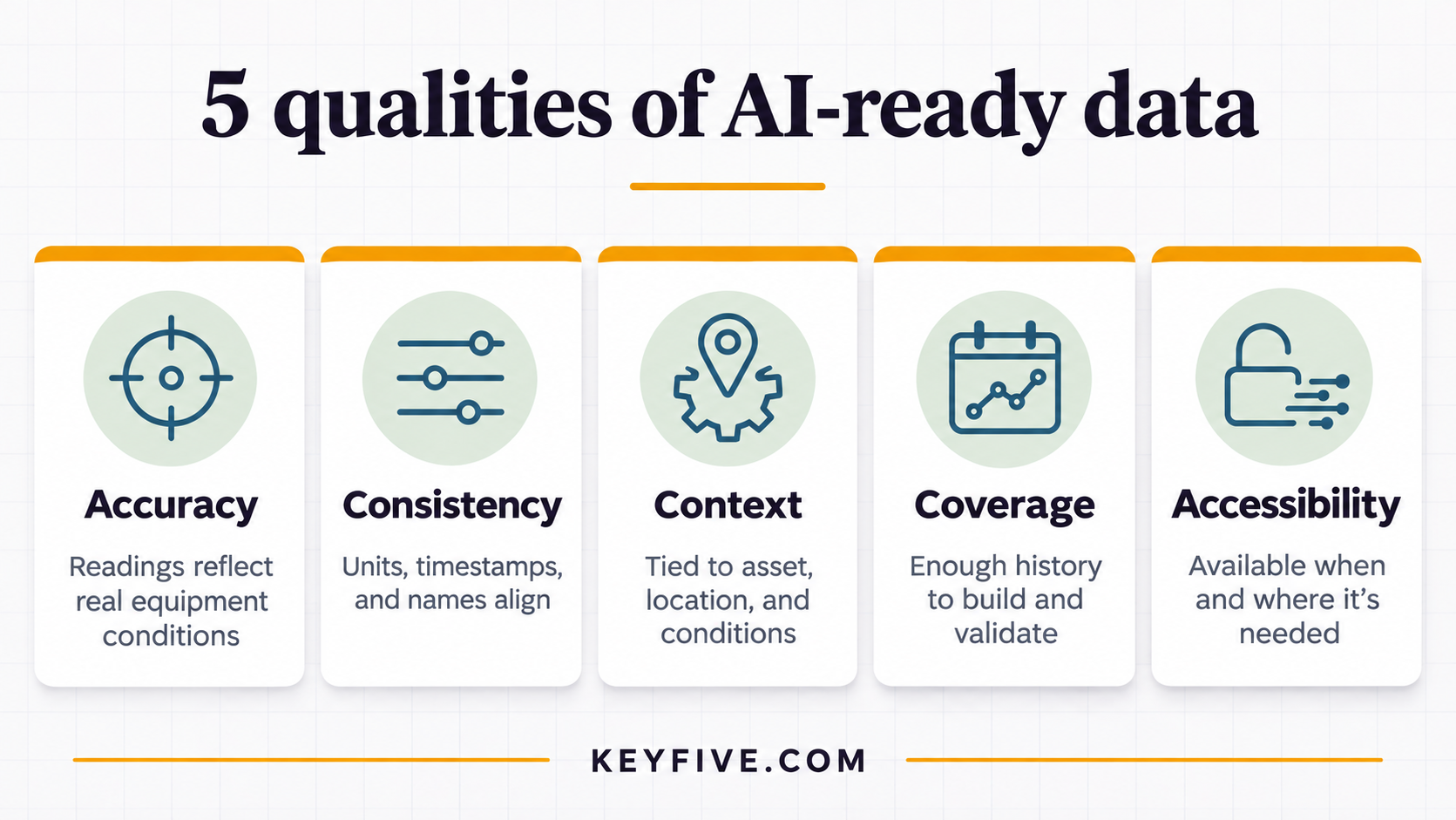
Accuracy: Readings reliably reflect equipment conditions, with faulty sensors, missing values, and recording errors identified and addressed.
Consistency: Units, timestamps, and naming conventions are aligned so information from different sources can be interpreted correctly.
Context: Data is associated with the relevant asset, location, and operating conditions. A vibration spike during startup may mean something different from the same spike during steady-state operation.
Coverage: The available data captures enough relevant operating history, across relevant conditions, to develop and validate the intended AI application.
Accessibility: Authorized systems and users can reliably access the information at the frequency the application requires.
Your data needs to give AI the information it requires to perform the task you want it to do. An organization may have years of stored data and still be missing a critical measurement. It may also have the right data but lack the formatting and context needed for AI to use it effectively.
Why industrial data often falls short
Industrial data is often collected to support equipment control, operator visibility, and historical reporting. Those purposes do not necessarily require the detail, organization, or context needed for a particular AI application.
Information may also be fragmented across systems. Sensor readings reside in a historian, maintenance records in a separate application, and equipment knowledge with experienced personnel. Connecting a change in equipment behavior to a previous repair or known operating issue becomes difficult when those sources remain isolated.
Differences in equipment, vendors, and site configurations add another challenge. Similar assets may use different naming conventions, measurement units, or sampling rates. Some systems may retain only summarized readings, leaving out brief changes that could matter when analyzing a developing fault.
Even accurate readings can be difficult to interpret without operating context. A rise in temperature could reflect equipment degradation, a heavier production load, or a change in ambient conditions. Without that context, an AI model may struggle to distinguish normal variation from a meaningful warning sign.
Assess your data readiness through a focused pilot
Start by identifying a specific operational problem AI could help your team solve. Keep the pilot focused on a selected asset or process and define what a useful result would look like. For equipment degradation, that might mean identifying warning signs early enough for the maintenance team to investigate and act.
Working with your operations and maintenance teams and an experienced technical partner, use the pilot to:
Identify the information required. Establish which measurements, equipment records, and operating conditions are relevant to the problem.
Review what is available. Determine where that information resides, how it can be accessed, and whether it contains the necessary history and level of detail.
Check quality and context. Look for missing readings, inconsistent units, misaligned timestamps, and unclear asset identification. Confirm that maintenance events and operating conditions can be connected to the relevant readings.
Test whether the analysis is useful. Evaluate whether AI can produce results that help your team address the selected problem.
Prepare your operational data for AI with Keyfive
Keyfive helps industrial organizations connect data from existing equipment and operational systems, standardize information across sources, and add the asset context needed to support analytics and AI applications.
Whether you’re considering a focused pilot or preparing for broader adoption, we can help you evaluate your data foundation and identify the integration work needed to support your operational objectives.
Request an assessment to discuss your goals and how Keyfive can help prepare your operational data for AI.