
Most modernization projects aim to make your whole system run more efficiently, and that only works when data from every site, vendor, and piece of equipment is effectively integrated. Because that integration is specialized work that most in-house teams don’t have time for, many companies bring in an industrial software partner to do it.
It is not a decision to take lightly. Whoever connects your data decides how it's structured, where it lives, and who can reach it. Each consideration will have an impact for years to come.
In IIoT World's 2026 Industrial AI Readiness Report, 272 industrial professionals listed data quality and availability (54%), legacy systems and data silos (48%), and data trust and explainability (43%) as the top barriers to industrial AI. The wrong partners can make any of those issues worse.
Here are five questions to ask a software vendor before the project starts and what to listen for in their response.
1. Can you integrate with our legacy equipment and existing systems?
The most flexible and scalable solutions connect to the controllers, historians, and protocols you already run, without requiring you to replace them or add a layer of new hardware first.
Most industrial sites run a mix of equipment from different vendors, installed over decades. Your provider should be comfortable with Modbus, OPC UA, and MQTT, along with the older proprietary systems that still run a lot of critical equipment.
Pay attention to how a provider talks about your older equipment. If the plan starts with replacing it, that’s a much bigger and more expensive project, and it should be priced and planned as one.
2. How do you plan to both collect and contextualize data?
Your software provider should have a plan for cleaning, normalizing, and contextualizing data across equipment and sites.
Rockwell Automation's 2026 State of Smart Manufacturing report found that manufacturers use only 43% of the data they collect effectively.
Moving data into one place is the easy part. The harder and more valuable work is making it consistent: the same units, time zones and sample rates across every site, and every reading tied to the right asset. For example, a tag called "PT-104" is only useful once everyone knows it's the discharge pressure on pump 2 at the north site.
This is the difference between a data lake and data you can act on.
3. Will we own our data?
Your operational data belongs to you, so any solution you explore should ensure that the way it's collected, integrated, or stored doesn't make it hard to use with other tools later.
ARC Advisory Group made this point in June 2026, recommending open standards and APIs and warning against architectures that lock companies into a single vendor's system.
In practice, that means you should be able to export your data in a standard format, connect other software to it, and maintain ownership over your data if the relationship ends.
4. How do you keep connections to our OT environment secure?
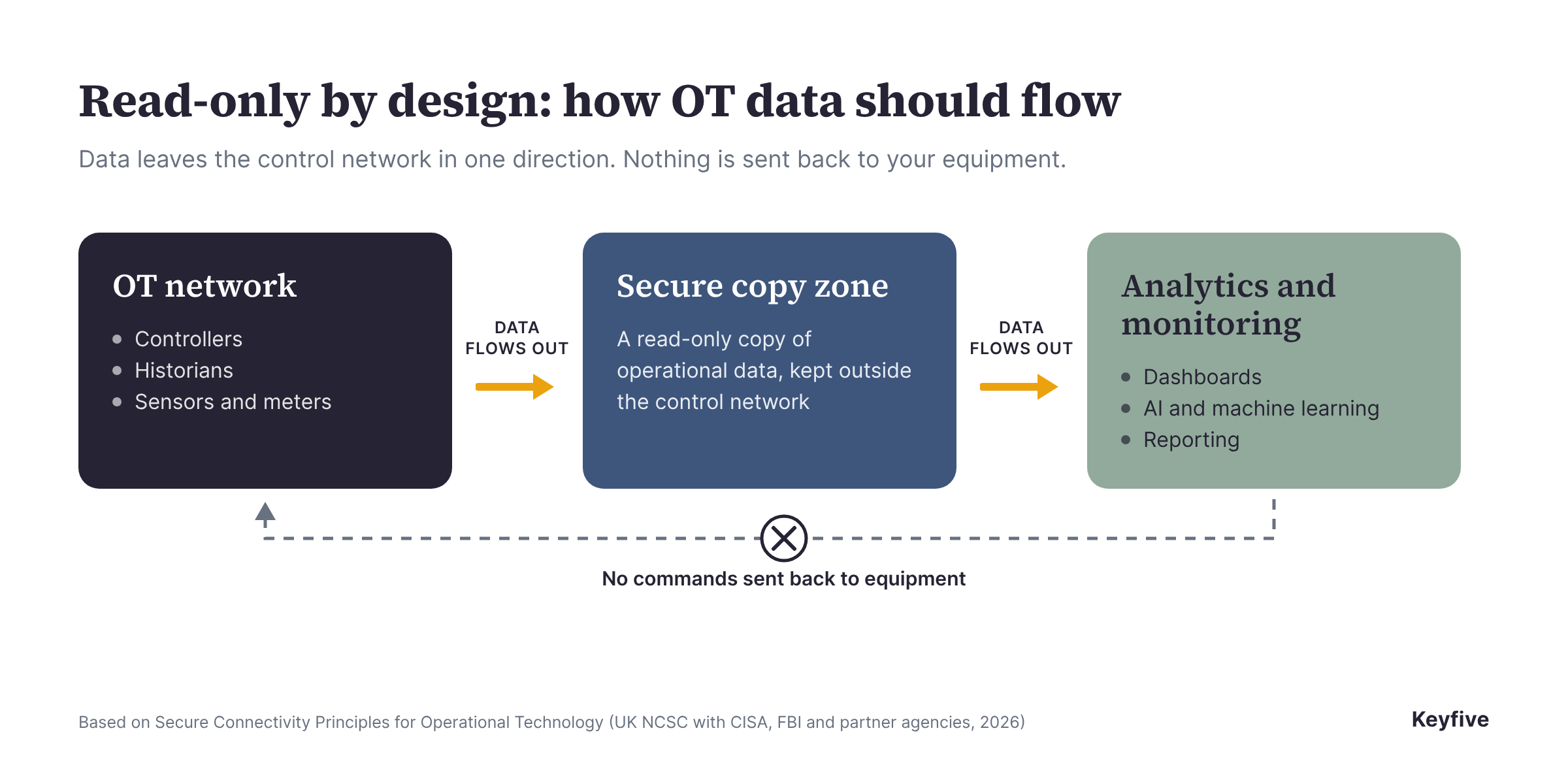
Connecting operational technology to anything outside it creates risk, and a good partner considers it a part of the design from day one.
In 2026, the UK's National Cyber Security Centre published "Secure connectivity principles for Operational Technology (OT)." Among their recommendations: connections should start from inside the OT network, data should flow outward in one direction wherever possible, and IT systems should read from a copy of operational data rather than reaching into the control network itself.
For data integration work involving system advisory or monitoring, the partner only needs to read your data, not change anything or access controls. Ask whether their approach is read-only, and whether their system could ever send a command back to your equipment. You want a clear answer to both.
5. What will our partnership look like?
The right partner understands that no one knows your equipment better than the people who run it every day and will work directly alongside your team to develop and manage a successful data solution.
Your operators and engineers know which alarms matter, which readings drift every summer, and which unit has always run a little hot. The best results come from a partnership, where the integration team handles the data, and your people supply the context.
A good partner brings enough operational experience to ask the right questions, then works with your team to make sense of what the data shows. Be cautious of anyone who claims to be the expert on your systems before they've seen them or is willing to walk away as soon as a system goes live.
Red flags when choosing a data integration partner
A few things are worth a second look when they come up in a sales conversation:
The plan starts with replacing equipment. That might be the right call eventually, but it's a different and much bigger project.
Your data ends up in a proprietary format. If you can't easily get it out, you're locked in.
Vague answers about security. "It's secure" isn't an answer. You should hear how connections are made and understand if/how control systems will be impacted.
AI promises before anyone has looked at your data. No one can tell you what AI will find until they know what your data looks like.
No defined first use case. A good project starts with one clear problem, a timeline and a way to tell whether it worked.
How Keyfive approaches software partnerships and builds
Keyfive is vendor-agnostic, connecting to the equipment and systems you already run. Our team brings expertise in OT data, software engineering, and AI, and works directly with industrial operators and engineers to make those systems run effectively across each operating environment.
Every project begins by making data more usable by cleaning and normalizing data. From there, we prove value through read-only, advisory solutions that use the data clients are already collecting to demonstrate potential of AI/ML.
All of our solutions are secure by design, involving edge security, multiple layers of encryption, data segmentation, auditing, and secure third-party integrations.
Most importantly, our promise is that your data stays yours.
Kickstart your next industrial software project with these free resources:
Are you ready for your next modernization project? Complete the Data Readiness Check
Want to see if Keyfive’s solutions are right for you? Request a free, no-touch assessment.
Frequently asked questions
What is industrial data integration?
Industrial data integration connects data from controllers, historians, sensors, and maintenance systems across sites and vendors, then standardizes it so it can be used in one place. It’s what makes fleet-wide monitoring, reporting, and AI possible.Do I need to replace legacy equipment to integrate my data?
Usually not. Most integration works on top of the systems you already run, connecting to existing controllers and historians through standard protocols like Modbus, OPC UA, and MQTT.Is it safe to connect OT systems to outside software?
It can be, when connections are designed for it. Current guidance from CISA and the UK’s NCSC recommends connections that start inside the OT network, send data out in one direction, and give outside systems read-only access.Who owns the data in an industrial software project?
You should. Look for a provider that uses open standards and standard export formats, so you can move or reuse your data if the relationship ends.What should the first phase of a data integration project include?
A good first phase cleans and normalizes your data, then focuses on one clear problem with a timeline and a way to measure results.