
How Asset Performance Management Software Turns Your Sensors Into an Actionable AI Platform
Summary: Raw operational data doesn't create a competitive advantage, but structured and refined operational data can be an invaluable asset for your company. This post lays out the criteria for transforming your data into a defensible asset, the safeguards required to protect it, and how Keyfive can do this for your organization.
Companies that manage high-value assets and highly coordinated supply chains rely on sensors to track everything from temperature to vibration to shock.
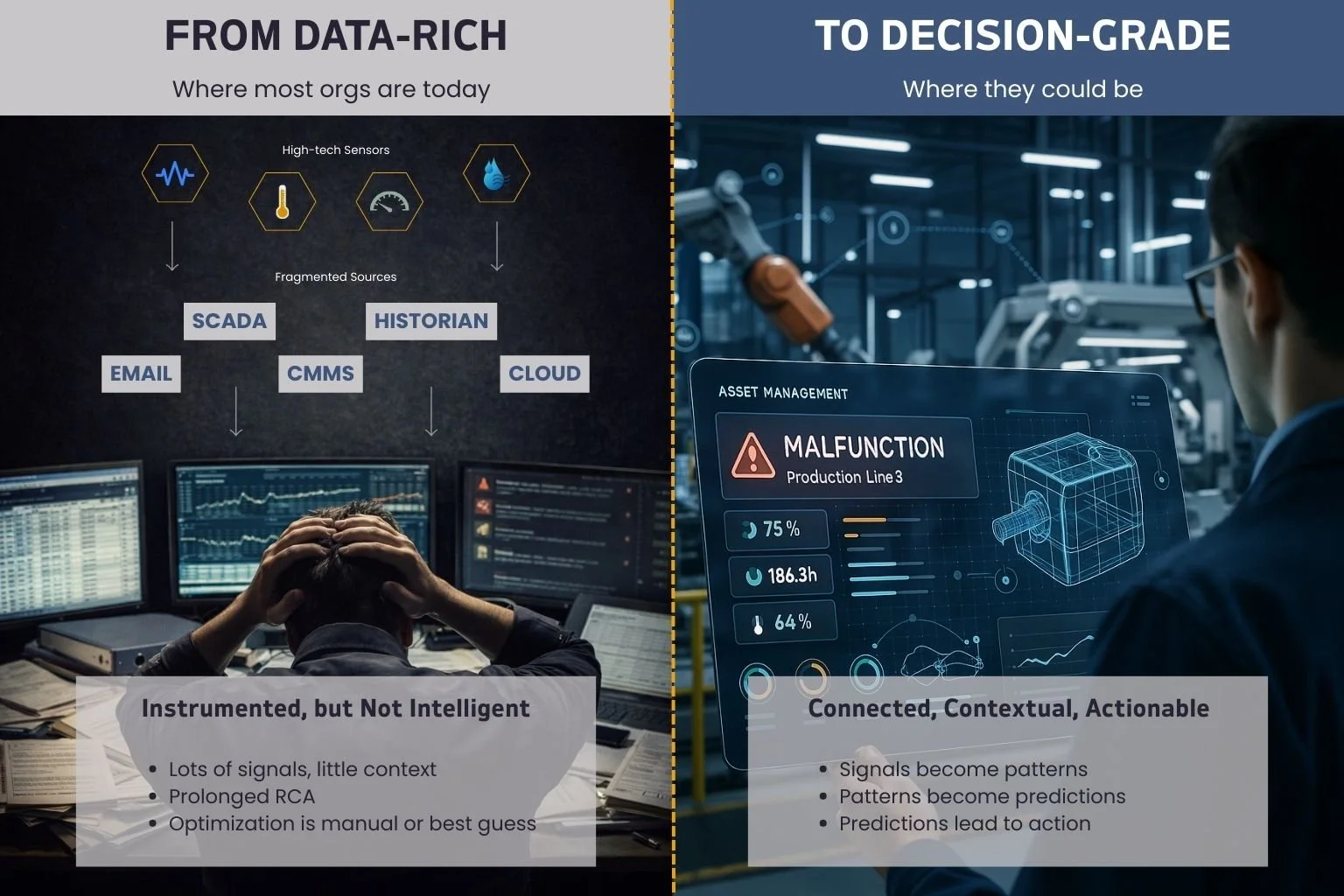
Over the past two decades, sensor accuracy, sensitivity, and capability have improved dramatically, yet the level of operational insight to assess the health and performance of the entire system — not just individual components — is still limited.
Modern sensor technology can capture, transmit, and store staggering quantities of multimodal data. However, without analytical systems to interpret that information, organizations are left with vast volumes of data tables displaying recorded events. This “naked” data alone cannot explain why events occurred, whether systemic issues are affecting performance, or what actions should be taken to optimize operations.
IBM has estimated that 90% of all sensor data collected from Internet of Things (IoT) devices becomes “dark,” meaning it is collected but never utilized.
This data represents an untapped resource that can be used to transform how organizations manage — and maximize — their entire operation, including assets, systems, and fleets.
Connecting multimodal sensor data to industry 4.0 analytical systems leveraging secure, cross-system integrations and operational AI models grants operators and managers the capability to:
detect patterns
identify systemic issues that could be propagating
predict failures before they occur
make informed decisions that reduce downtime, prevent costly failures, and optimize maintenance and efficiency.
The hardware is already in place. What’s needed now is a framework that turns isolated sensor readings into coordinated, system-level intelligence.
The Limits of Traditional Sensor Monitoring
Traditional sensor monitoring is based on threshold detection. This means an event is recorded when a predefined limit is surpassed or status changed. Examples include sensors detecting out of range temperature readings or registering shock events.
Modern day sensors are very good at collecting sets of multimodal data and detecting if something happened, when, and for how long, in addition to other pertinent parameters.
But they do so in static isolation, exporting spreadsheets or logs for further analysis. This not only strips out valuable context but also introduces a lag with respect to when the data is collected and when it is utilized. If visualized correctly, these data sets can provide valuable insight into the performance of your entire system, operation, and supply chain.
However, because conventional sensor systems isolate data, and analysis only occurs post event, operators are only able to monitor downstream components of a system and address the question of “what happened?” in single instances — if at all.
They cannot correlate separate events to address why something happened or report on the system health in real-time. Furthermore, many organizations often fail to carry out important analyses that would bring underlying causes and systemic flaws to the surface, even retrospectively.
Clearly, this illustrates a stark limitation of traditional monitoring and how it can hinder productivity. Corrective action can only be taken in isolated incidents and only from a reactive position — assuming the root cause of the issue can even be identified.
Relying on traditional monitoring has major implications in practice and results in:
Downtime and disruptions: Machines or processes fail before anyone can intervene, leading to operational delays.
Higher maintenance costs: Emergency repairs and rushed interventions are more expensive than planned maintenance.
Limited insight for improvement: Since you’re only seeing symptoms, it’s difficult to perform root cause analysis (RCA) or identify systemic inefficiencies.
Risk amplification: Small issues propagate across the system unnoticed, jeopardizing broader operational integrity.
Thus, the right analytical system can unlock the potential of this data and amplify your entire operation.
From Data to Action — The Role of Asset Performance Management Software
Asset Performance Management (APM) software transforms static sensor data into a dynamic operational model that integrates events, assets, and system behavior in real time.
Unlike traditional monitoring, which reacts to isolated events, APM provides a holistic, predictive view across the entire system. Instead of independent data points for single assets, APM platforms associate multiple readings from multiple sensors and uncover patterns that answer the critical operational questions: “why did the event occur?” and “what is likely to happen next?”
This capability is transformative for organizations. It allows teams to optimize operations proactively, perform maintenance based on actual asset conditions rather than a fixed timetable, and mitigate risks before failures occur. The result is faster, smarter decision-making, reduced downtime, and improved overall operational efficiency.
While APM software enables this transformation conceptually, realizing it in your operation requires a partner that can implement these insights.
Keyfive does exactly that.
How Keyfive Turns Sensor Data Into Actionable Intelligence
At Keyfive, we help organizations transform raw sensor data into system-level intelligence that drives operational excellence. Our approach leverages digital twin models as the linchpin of our Asset Performance Management (APM) solutions to provide:
Predictive insights: Identify potential failures before they happen, allowing condition-based maintenance and proactive intervention.
System-wide visibility: Integrate readings from multiple sensors and assets to uncover patterns and systemic issues across the entire operation.
Actionable guidance: Distill out clear action items from complex, multi-variable datasets to enable faster and smarter decision-making.
Operational optimization: Reduce unplanned downtime, increase efficiency, and improve overall asset performance.
Keyfive’s digital twin technology unlocks actionable operational intelligence from the sensor data you’re already collecting. By engineering a living, digital replica of your assets, and how they interact as components in a larger system, our platform allows teams to observe the current state of their operation, predict the future state, and enable decisive action that improves reliability and efficiency.
To learn more about how Keyfive can elevate your operations and unlock the full potential of your sensor data, learn more about our data architecture or request a free, no-touch assessment.